Problem. To inscribe a circle in a regular pentagon (ABCDE).
Sol.—Bisect two adjacent angles A, B by the lines AO, BO; then O, the point of intersection of the bisectors, is the centre of the required circle.
Dem.—Join CO, and let fall perpendiculars from O on the five sides of the pentagon. Now the triangles ABO, CBO have the side AB equal to BC (hyp.), and BO common, and the angle ABO equal to CBO (const.). Hence the angle BAO is equal to BCO [I. iv.]; but BAO is half BAE (const.). Therefore BCO is half BCD, and therefore CO bisects the angle BCD. In like manner it may be proved that DO bisects the angle D, and EO the angle E.
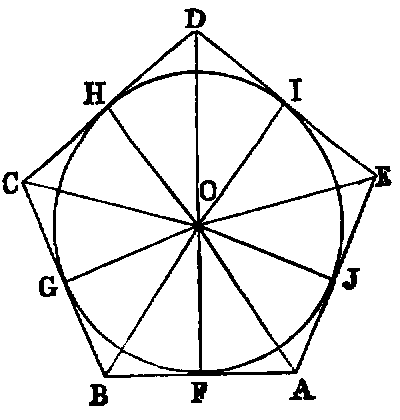
Again, the triangles BOF, BOG have the angle F equal to G, each being right; and OBF equal to OBG, because OB bisects the angle ABC (const.), and OB common; hence [I. xxvi.] OF is equal to OG. In like manner all the perpendiculars from O on the sides of the pentagon are equal; hence the circle whose centre is O, and radius OF, will touch all the sides of the pentagon, and will therefore be inscribed in it.
In the same manner a circle may be inscribed in any regular polygon.