Problem. To describe a regular pentagon about a given circle (ABCDE).
Sol.—Let the five points A, B, C, D, E on the circle be the vertices of any inscribed regular pentagon: at these points draw tangents FG, GH, HI, IJ, JF: the figure FGHIJ is a circumscribed regular pentagon.
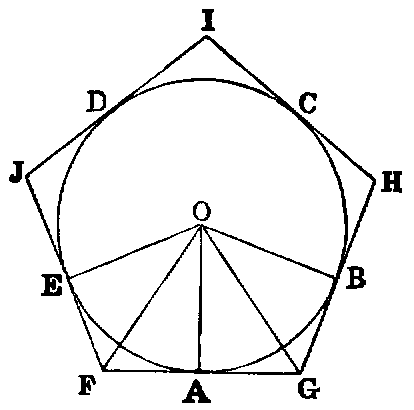
Dem.—Let O be the centre of the circle. Join OE, OA, OB. Now, because the angles A, E of the quadrilateral AOEF are right angles [III. xviii.], the sum of the two remaining angles AOE, AFE is two right angles. In like manner the sum of the angles AOB, AGB is two right angles; therefore the sum of AOE, AFE is equal to the sum of AOB, AGB; but the angles AOE, AOB are equal, because they stand on equal arcs AE, AB [III. xxvii.]. Hence the angle AFE is equal to AGB. In like manner the remaining angles of the figure FGHIJ are equal. Therefore it is equiangular.
Again, join OF, OG. Now the triangles EOF, AOF have the sides AF, FE equal [III. xvii., Ex. 1], and FO common, and the base AO equal to the base EO. Hence the angle AFO is equal to EFO [I. viii.]. Therefore the angle AFO is half the angle AFE. In like manner AGO is half the angle AGB; but AFE has been proved equal to AGB; hence AFO is equal to AGO, and FAO is equal to GAO, each being right, and AO common to the two triangles FAO, GAO; hence [I. xxvi.] the side AF is equal to AG; therefore GF is double AF. In like manner JF is double EF; but AF is equal to EF; hence GF is equal to JF. In like manner the remaining sides are equal; therefore the figure FGHIJ is equilateral, and it has been proved equiangular. Hence it is a regular pentagon.
This Proposition is a particular case of the following general theorem, of which the proof is the same as the foregoing:—
“If tangents be drawn to a circle, at the angular points of an inscribed polygon of any number of sides, they will form a regular polygon of the same number of sides circumscribed to the circle.”