Problem. To inscribe a regular pentagon in a given circle (ABCDE).
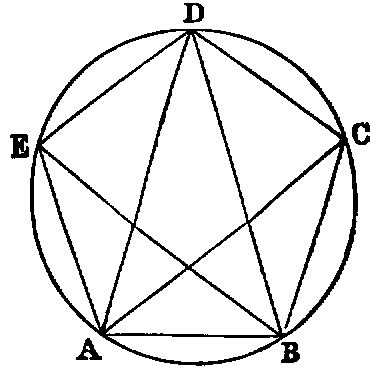
Sol.—Construct an isosceles triangle [x.], having each base angle double the vertical angle, and inscribe in the given circle a triangle ABD equiangular to it. Bisect the angles DAB, ABD by the lines AC, BE. Join EA, ED, DC, CB; then the figure ABCDE is a regular pentagon.
Dem.—Because each of the base angles BAD, ABD is double of the angle ADB, and the lines AC, BE bisect them, the five angles BAC, CAD, ADB, DBE, EBA are all equal; therefore the arcs on which they stand are equal; and therefore the five chords, AB, BC, CD, DE, EA are equal. Hence the figure ABCDE is equilateral.
Again, because the arcs AB, DE are equal, adding the arc BCD to both, the arc ABCD is equal to the arc BCDE, and therefore [III. xxvii.] the angles AED, BAE, which stand on them, are equal. In the same manner it can be proved that all the angles are equal; therefore the figure ABCDE is equiangular. Hence it is a regular pentagon.