Problem. To construct an isosceles triangle having each base angle double the vertical angle.
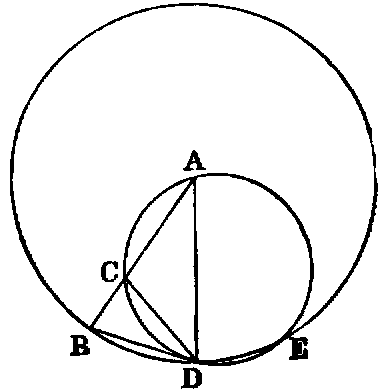
Sol.—Take any line AB. Divide it in C, so that the rectangle AB.BC shall be equal to AC2 [II. xi.]. With A as centre, and AB as radius, describe the circle BDE, and in it place the chord BD equal to AC [i.]. Join AD. ADB is a triangle fulfilling the required conditions.
Dem.—Join CD. About the triangle ACD describe the circle CDE [v.]. Then, because the rectangle AB.BC is equal to AC2 (const.), and that AC is equal to BD (const.); therefore the rectangle AB.BC is equal to BD2. Hence [III. xxxvii.] BD touches the circle ACD. Hence the angle BDC is equal to the angle A in the alternate segment [III. xxxii.]. To each add CDA, and we have the angle BDA equal to the sum of the angles CDA and A; but the exterior angle BCD of the triangle ACD is equal to the sum of the angles CDA and A. Hence the angle BDA is equal to BCD; but since AB is equal to AD, the angle BDA is equal to ABD; therefore the angle CBD is equal to BCD. Hence [I. vi.] BD is equal to CD; but BD is equal to AC (const.); therefore AC is equal to CD, and therefore [I. v.] the angle CDA is equal to A; but BDA has been proved to be equal to the sum of CDA and A. Hence BDA is double of A. Hence each of the base angles of the triangle ABD is double of the vertical angle.