The same things still supposed, I say, in the second place, that the total force or power of all the particles situated every where about the sphere to turn the earth about the said axis is to the whole force of the like number of particles, uniformly disposed round the whole circumference of the equator AE in the fashion of a ring, to turn the whole earth about with the like circular motion, as 2 to 5.
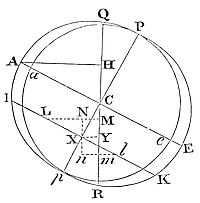
For let IK be any lesser circle parallel to the equator AE, and let Ll be any two equal particles in this circle, situated without the sphere Pape; and if upon the plane QR, which is at right angles with a radius drawn to the sun, we let fall the perpendiculars LM, lm, the total forces by which these particles recede from the plane QR will be proportional to the perpendiculars LM, lm. Let the right line Ll be drawn parallel to the plane Pape, and bisect the same in X; and through the point X draw Nn parallel to the plane QR, and meeting the perpendiculars LM, lm, in N and n; and upon the plane QR let fall the perpendicular XY. And the contrary forces of the particles L and l to wheel about the earth contrariwise are as LM × MC, and lm × mC; that is, as LN × MC + NM × MC, and ln × mC - nm × mC; or LN × MC + NM × MC, and LN × mC - NM × mC, and LN × Mm−NM × MC+mC, the difference of the two, is the force of both taken together to turn the earth round. The affirmative part of this difference LN × Mm, or 2LN × NX, is to 2AH × HC, the force of two particles of the same size situated in A, as LX2 to AC2; and the negative part NM × MC+mC, or 2XY × CY, is to 2AH × HC, the force of the same two particles situated in A, as CX2 to AC2. And therefore the difference of the parts, that is, the force of the two particles L and l, taken together, to wheel the earth about, is to the force of two particles, equal to the former and situated in the place A, to turn in like manner the earth round, as LX2 - CX2 to AC2. But if the circumference IK of the circle IK is supposed to be divided into an infinite number of little equal parts L, all the LX2 will be to the like number of IX2 as 1 to 2 (by Lem. 1); and to the same number of AC2 as IX2 to 2AC2; and the same number of CX2 to as many AC2 as 2CX2 to 2AC2. Wherefore the united forces of all the particles in the circumference of the circle IK are to the joint forces of as many particles in the place A as IX2 - 2CX2 to 2AC2; and therefore (by Lem. 1) to the united forces of as many particles in the circumference of the circle AE as IX2 - 2CX2 to AC2.
Now if Pp, the diameter of the sphere, is conceived to be divided into an infinite number of equal parts, upon which a like number of circles IK are supposed to insist, the matter in the circumference of every circle IK will be as IX2; and therefore the force of that matter to turn the earth about will be as IX2 into IX2 - 2CX2; and the force of the same matter, if it was situated in the circumference of the circle AE, would be as IX2 into AC2. And therefore the force of all the particles of the whole matter situated without the sphere in the circumferences of all the circles is to the force of the like number of particles situated in the circumference of the greatest circle AE as all the IX2 into IX2 - 2CX2 to as many IX2 into AC2; that is, as all the AC2 - CX2 into AC2 - 3CX2 to as many AC2 - CX2 into AC2; that is, as all the AC4 - 4AC2 × CX2 + 3CX4 to as many AC4 - AC2 × CX2; that is, as the whole fluent quantity, whose fluxion is AC4 - 4AC2 × CX2 + 3CX4, to the whole fluent quantity, whose fluxion is AC4 - AC2 × CX2; and, therefore, by the method of fluxions, as AC⁴ × CX−^(4/3)AC² × CX³+^(3/5)CX⁵ to AC⁴ × CX−^(1/3)AC² × CX³; that is, if for CX we write the whole Cp, or AC, as ^(4/15)AC⁵ to ^(2/3)AC⁵; that is, as 2 to 5. Q.E.D.