If APEp represent the earth uniformly dense, marked with the centre C, the poles P, p, and the equator AE; and if about the centre C, with the radius CP, we suppose the sphere Pape to be described, and QR to denote the plane on which a right line, drawn from the centre of the sun to the centre of the earth, insists at right angles; and further suppose that the several particles of the whole exterior earth PapAPepE, without the height of the said sphere, endeavour to recede towards this side and that side from the plane QR, every particle by a force proportional to its distance from that plane; I say, in the first place, that the whole force and efficacy of all the particles that are situate in AE, the circle of the equator, and disposed uniformly without the globe, encompassing the same after the manner of a ring, to wheel the earth about its centre, is to the whole force and efficacy of as many particles in that point A of the equator which is at the greatest distance from the plane QR, to wheel the earth about its centre with a like circular motion, as 1 to 2. And that circular motion will be performed about an axis lying in the common section of the equator and the plane QR.
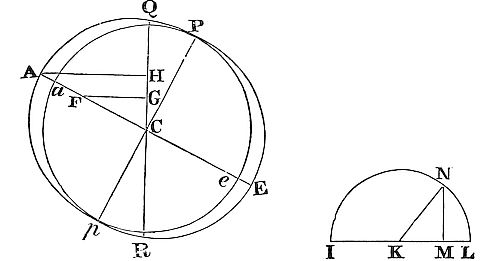
For let there be described from the centre K, with the diameter IL, the semi-circle INL. Suppose the semi-circumference INL to be divided into innumerable equal parts, and from the several parts N to the diameter IL let fall the sines NM. Then the sums of the squares of all the sines NM will be equal to the sums of the squares of the sines KM, and both sums together will be equal to the sums of the squares of as many semi-diameters KN; and therefore the sum of the squares of all the sines NM will be but half so great as the sum of the squares of as many semi-diameters KN.
Suppose now the circumference of the circle AE to be divided into the like number of little equal parts, and from every such part F a perpendicular FG to be let fall upon the plane QR, as well as the perpendicular AH from the point A. Then the force by which the particle F recedes from the plane QR will (by supposition) be as that perpendicular FG; and this force multiplied by the distance CG will represent the power of the particle F to turn the earth round its centre. And, therefore, the power of a particle in the place F will be to the power of a particle in the place A as FG × GC to AH × HC; that is, as FC2 to AC2: and therefore the whole power of all the particles F, in their proper places F, will be to the power of the like number of particles in the place A as the sum of all the FC2 to the sum of all the AC2, that is (by what we have demonstrated before) as 1 to 2. Q.E.D.
And because the action of those particles is exerted in the direction of lines perpendicularly receding from the plane QR, and that equally from each side of this plane, they will wheel about the circumference of the circle of the equator, together with the adherent body of the earth, round an axis which lies as well in the plane QR as in that of the equator.