"The mean motion of the sun from the node is defined by a geometric mean proportional between the mean motion of the sun and that mean motion with which the sun recedes with the greatest swiftness from the node in the quadratures.
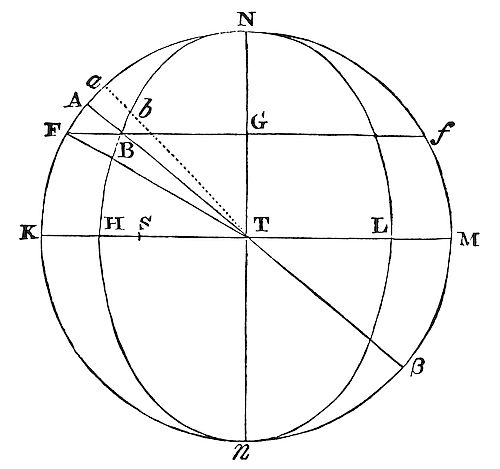
"Let T be the earth's place, Nn the line of the moon's nodes at any given time, KTM a perpendicular thereto, TA a right line revolving about the centre with the same angular velocity with which the sun and the node recede from one another, in such sort that the angle between the quiescent right line Nn and the revolving line TA may be always equal to the distance of the places of the sun and node. Now if any right line TK be divided into parts TS and SK, and those parts be taken as the mean horary motion of the sun to the mean horary motion of the node in the quadratures, and there be taken the right line TH, a mean proportional between the part TS and the whole TK, this right line will be proportional to the sun's mean motion from the node.
"For let there be described the circle NKnM from the centre T and with the radius TK, and about the same centre, with the semi-axis TH and TN, let there be described an ellipsis NHnL; and in the time in which the sun recedes from the node through the arc Na, if there be drawn the right line Tba, the area of the sector NTa will be the exponent of the sum of the motions of the sun and node in the same time. Let, therefore, the extremely small arc aA be that which the right line Tba, revolving according to the aforesaid law, will uniformly describe in a given particle of time, and the extremely small sector TAa will be as the sum of the velocities with which the sun and node are carried two different ways in that time. Now the sun's velocity is almost uniform, its inequality being so small as scarcely to produce the least inequality in the mean motion of the nodes. The other part of this sum, namely, the mean quantity of the velocity of the node, is increased in the recess from the syzygies in a duplicate ratio of the sine of its distance from the sun (by Cor. Prop. XXXI, of this Book), and, being greatest in its quadratures with the sun in K, is in the same ratio to the sun's velocity as SK to TS, that is, as (the difference of the squares of TK and TH, or) the rectangle KHM to TH2. But the ellipsis NBH divides the sector ATa, the exponent of the sum of these two velocities, into two parts ABba and BTb, proportional to the velocities. For produce BT to the circle in 𝛽, and from the point B let fall upon the greater axis the perpendicular BG, which being produced both ways may meet the circle in the points F and f; and because the space ABba is to the sector TBb as the rectangle AB𝛽 to BT2 (that rectangle being equal to the difference of the squares of TA and TB, because the right line A𝛽 is equally cut in T, and unequally in B), therefore when the space ABba is the greatest of all in K, this ratio will be the same as the ratio of the rectangle KHM to HT2. But the greatest mean velocity of the node was shewn above to be in that very ratio to the velocity of the sun; and therefore in the quadratures the sector ATa is divided into parts proportional to the velocities.
And because the rectangle KHM is to HT2 as FBf to BG2, and the rectangle AB𝛽 is equal to the rectangle FBf, therefore the little area ABba, where it is greatest, is to the remaining sector TBb as the rectangle AB𝛽 to BG2 But the ratio of these little areas always was as the rectangle AB𝛽 to BT2; and therefore the little area ABba in the place A is less than its correspondent little area in the quadratures in the duplicate ratio of BG to BT, that is, in the duplicate ratio of the sine of the sun's distance from the node. And therefore the sum of all the little areas ABba, to wit, the space ABN, will be as the motion of the node in the time in which the sun hath been going over the arc NA since he left the node; and the remaining space, namely, the elliptic sector NTB, will be as the sun's mean motion in the same time. And because the mean annual motion of the node is that motion which it performs in the time that the sun completes one period of its course, the mean motion of the node from the sun will be to the mean motion of the sun itself as the area of the circle to the area of the ellipsis; that is, as the right line TK to the right line TH, which is a mean proportional between TK and TS; or, which comes to the same as the mean proportional TH to the right line TS.