To find the true motion of the nodes of the moon.
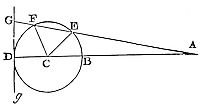
In the time which is as the area NTA - NdZ (in the preceding Fig.) that motion is as the area NAe, and is thence given; but because the calculus is too difficult, it will be better to use the following construction of the Problem. About the centre C, with any interval CD, describe the circle BEFD; produce DC to A so as AB may be to AC as the mean motion to half the mean true motion when the nodes are in their quadratures (that is, as 19° 18' 1'' 23''' to 19° 49' 3'' 55'''; and therefore BC to AC as the difference of those motions 0° 31' 2'' 32''' to the latter motion 19° 49' 3'' 55'', that is, as 1 to 38^(3/10) ). Then through the point D draw the indefinite line Gg, touching the circle in D; and if we take the angle BCE, or BCF, equal to the double distance of the sun from the place of the node, as found by the mean motion, and drawing AE or AF cutting the perpendicular DG in G, we take another angle which shall be to the whole motion of the node in the interval between its syzygies (that is, to 9° 11'' 3''') as the tangent DG to the whole circumference of the circle BED, and add this last angle (for which the angle DAG may be used) to the mean motion of the nodes, while they are passing from the quadratures to the syzygies, and subtract it from their mean motion while they are passing from the syzygies to the quadratures, we shall have their true motion; for the true motion so found will nearly agree with the true motion which comes out from assuming the times as the area NTA - NdZ, and the motion of the node as the area NAe; as whoever will please to examine and make the computations will find: and this is the semi-menstrual equation of the motion of the nodes. But there is also a menstrual equation, but which is by no means necessary for finding of the moon's latitude; for since the variation of the inclination of the moon's orbit to the plane of the ecliptic is liable to a twofold inequality, the one semi-menstrual, the other menstrual, the menstrual inequality of this variation, and the menstrual equation of the nodes, so moderate and correct each other, that in computing the latitude of the moon both may be neglected.
COR. From this and the preceding Prop. it appears that the nodes are quiescent in their syzygies, but regressive in their quadratures, by an hourly motion of 16'' 19''' 26iv.; and that the equation of the motion of the nodes in the octants is 1° 30'; all which exactly agree with the phænomena of the heavens.
SCHOLIUM.
Mr. Machin, Astron., Prof. Gresh., and Dr. Henry Pemberton, separately found out the motion of the nodes by a different method. Mention has been made of this method in another place. Their several papers, both of which I have seen, contained two Propositions, and exactly agreed with each other in both of them. Mr. Machin's paper coming first to my hands, I shall here insert it.