Among heavy prisms and cylinders of similar figure, there is one and only one which under the stress of its own weight lies just on the limit between breaking and not breaking: so that every larger one is unable to carry the load of its own weight and breaks; while every smaller one is able to withstand some additional force tending to break it.
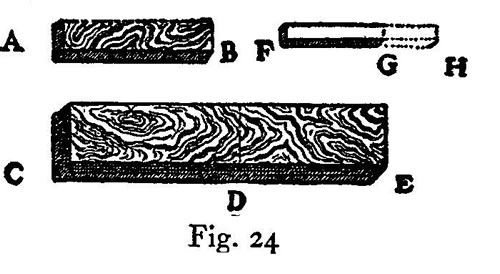
Let AB be a heavy prism, the longest possible that will just sustain its own weight, so that if it be lengthened the least bit it will break. Then, I say, this prism is unique among all similar prisms—infinite in number—in occupying that boundary line between breaking and not breaking; so that every larger one will break under its own weight, and every smaller one will not break, but will be able to withstand some force in addition to its own weight.
Let the prism CE be similar to, but larger than, AB: then, I say, it will not remain intact but will break under its own weight. Lay off the portion CD, equal in length to AB. And, since, the resistance [bending strength] of CD is to that of AB as the cube of the thickness of CD is to the cube of the thickness of AB, that is, as the prism CE is to the similar prism AB, it follows that the weight of CE is the utmost load which a prism of the length CD can sustain; but the length of CE is greater; therefore the prism CE will break. Now take another prism FG which is smaller than AB. Let FH equal AB, then it can be shown in a similar manner that the resistance [bending strength] of FG is to that of AB as the prism FG is to the prism AB provided the distance AB that is FH, is equal to the distance FG; but AB is greater than FG, and therefore the moment of the prism FG applied at G is not sufficient to break the prism FG.
The demonstration is short and clear; while the proposition which, at first glance, appeared improbable is now seen to be both true and inevitable. In order therefore to bring this prism into that limiting condition which separates breaking from not breaking, it would be necessary to change the ratio between thickness and length either by increasing the thickness or by diminishing the length. An investigation of this limiting state will, I believe, demand equal ingenuity.
Nay, even more; for the question is more difficult; this I know because I spent no small amount of time in its discovery which I now wish to share with you.