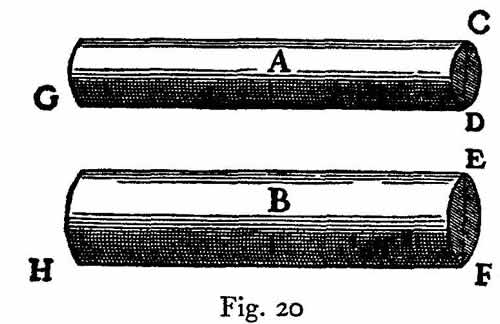
In prisms and cylinders of equal length, but of unequal thicknesses, the resistance to fracture increases in the same ratio as the cube of the diameter of the thickness, i. e., of the base.
Let A and B be two cylinders of equal lengths DG, FH; let their bases be circular but unequal, having the diameters CD and EF. Then I say that the resistance to fracture offered by the cylinder B is to that offered by A as the cube of the diameter FE is to the cube of the diameter DC. For, if we consider the resistance to fracture by longitudinal pull as dependent upon the bases, i. e., upon the circles EF and DC, no one can doubt that the strength [resistenza] of the cylinder B is greater than that of A in the same proportion in which the area of the circle EF exceeds that of CD; because it is precisely in this ratio that the number of fibres binding the parts of the solid together in the one cylinder exceeds that in the other cylinder.
But in the case of a force acting transversely it must be remembered that we are employing two levers in which the forces are applied at distances DG, FH, and the fulcrums are located at the points D and F; but the resistances are applied at distances which are equal to the radii of the circles DC and EF, since the fibres distributed over these entire cross-sections act as if concentrated at the centers. Remembering this and remembering also that the arms, DG and FH, through which the forces G and H act are equal, we can understand that the resistance, located at the center of the base EF, acting against the force at H, is more effective [maggiore] than the resistance at the center of the base CD opposing the force G, in the ratio of the radius FE to the radius DC. Accordingly the resistance to fracture offered by the cylinder B is greater than that of the cylinder A in a ratio which is compounded of that of the area of the circles EF and DC and that of their radii, i. e., of their diameters; but the areas of circles are as the squares of their diameters. Therefore the ratio of the resistances, being the product of the two preceding ratios, is the same as that of the cubes of the diameters. This is what I set out to prove. Also since the volume of a cube varies as the third power of its edge we may say that the resistance [strength] of a cylinder whose length remains constant varies as the third power of its diameter.
From the preceding we are able to conclude that
Corollary
The resistance [strength] of a prism or cylinder of constant length varies in the sesquialteral ratio of its volume.
This is evident because the volume of a prism or cylinder of constant altitude varies directly as the area of its base, i. e., as the square of a side or diameter of this base; but, as just demonstrated, the resistance [strength] varies as the cube of this same side or diameter. Hence the resistance varies in the sesquialteral ratio of the volume—consequently also of the weight—of the solid itself.
Before proceeding further I should like to have one of my difficulties removed. Up to this point you have not taken into consideration a certain other kind of resistance which, it appears to me, diminishes as the solid grows longer, and this is quite as true in the case of bending as in pulling; it is precisely thus that in the case of a rope we observe that a very long one is less able to support a large weight than a short one. Whence, I believe, a short rod of wood or iron will support a greater weight than if it were long, provided the force be always applied longitudinally and not transversely, and provided also that we take into account the weight of the rope itself which increases with its length.
I fear, Simplicio, if I correctly catch your meaning, that in this particular you are making the same mistake as many others; that is if you mean to say that a long rope, one of perhaps 40 cubits, cannot hold up so great a weight as a shorter length, say one or two cubits, of the same rope.
That is what I meant, and as far as I see the proposition is highly probable.
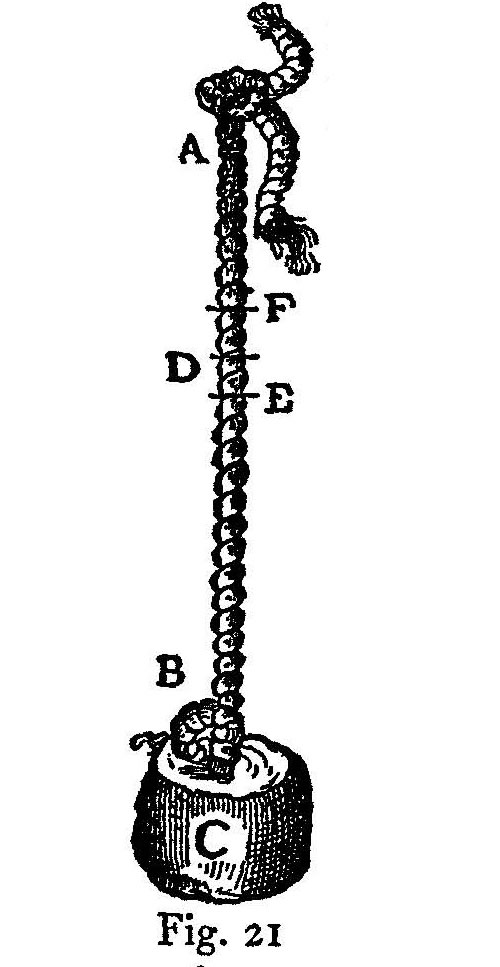
On the contrary, I consider it not merely improbable but false; and I think I can easily convince you of your error. Let AB represent the rope, fastened at the upper end A: at the lower end attach a weight C whose force is just sufficient to break the rope. Now, Simplicio, point out the exact place where you think the break ought to occur.
Let us say D.
And why at D?
Because at this point the rope is not strong enough to support, say, 100 pounds, made up of the portion of the rope DB and the stone C.
Accordingly whenever the rope is stretched [violentata] with the weight of 100 pounds at D it will break there.
I think so.
But tell me, if instead of attaching the weight at the end of the rope, B, one fastens it at a point nearer D, say, at E: or if, instead of fixing the upper end of the rope at A, one fastens it at some point F, just above D, will not the rope, at the point D, be subject to the same pull of 100 pounds?
It would, provided you include with the stone C the portion of rope EB.
Let us therefore suppose that the rope is stretched at the point D with a weight of 100 pounds, then according to your own admission it will break; but FE is only a small portion of AB; how can you therefore maintain that the long rope is weaker than the short one? Give up then this erroneous view which you share with many very intelligent people, and let us proceed.
Now having demonstrated that, in the case of [uniformly loaded] prisms and cylinders of constant thickness, the moment of force tending to produce fracture [momento sopra le proprie resistenze] varies as the square of the length; and having likewise shown that, when the length is constant and the thickness varies, the resistance to fracture varies as the cube of the side, or diameter, of the base, let us pass to the investigation of the case of solids which simultaneously vary in both length and thickness. Here I observe that,