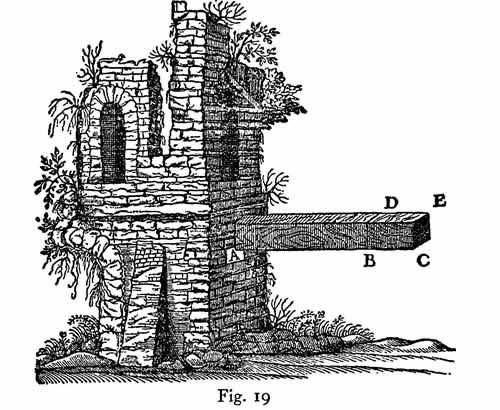
Considering now the case of a prism or cylinder growing longer in a horizontal direction, we must find out in what ratio the moment of its own weight increases in comparison with its resistance to fracture. This moment I find increases in proportion to the square of the length. In order to prove this let AD be a prism or cylinder lying horizontal with its end A firmly fixed in a wall. Let the length of the prism be increased by the addition of the portion BE. It is clear that merely changing the length of the lever from AB to AC will, if we disregard its weight, increase the moment of the force [at the end] tending to produce fracture at A in the ratio of CA to BA. But, besides this, the weight of the solid portion BE, added to the weight of the solid AB increases the moment of the total weight in the ratio of the weight of the prism AE to that of the prism AB, which is the same as the ratio of the length AC to AB.
It follows, therefore, that, when the length and weight are simultaneously increased in any given proportion, the moment, which is the product of these two, is increased in a ratio which is the square of the preceding proportion. The conclusion is then that the bending moments due to the weight of prisms and cylinders which have the same thickness but different lengths, bear to each other a ratio which is the square of the ratio of their lengths, or, what is the same thing, the ratio of the squares of their lengths.
We shall next show in what ratio the resistance to fracture [bending strength], in prisms and cylinders, increases with increase of thickness while the length remains unchanged. Here I say that