To determine the momentum of a projectile at each particular point in its given parabolic path.
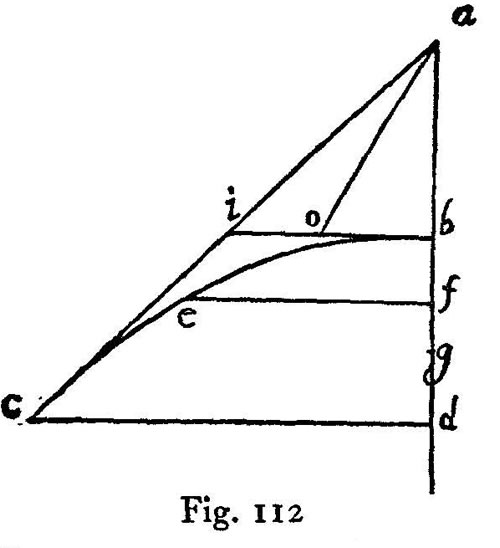
Let bec be the semi-parabola whose amplitude is cd and whose height is db, which latter extended upwards cuts the tangent of the parabola ca in a. Through the vertex draw the horizontal line bi parallel to cd. Now if the amplitude cd is equal to the entire height da, then bi will be equal to ba and also to bd; and if we take ab as the measure of the time required for fall through the distance ab and also of the momentum acquired at b in consequence of its fall from rest at a, then if. we turn into a horizontal direction the momentum acquired by fall through ab [impetum ab] the space traversed in the same interval of time will be represented by dc which is twice bi. But a body which falls from rest at b along the line bd will during the same time-interval fall through the height of the parabola bd. Hence a body falling from rest at a, turned into a horizontal direction with the speed ab will traverse a space equal to dc. Now if one superposes upon this motion a fall along bd, traversing the height bd while the parabola bc is described, then the momentum of the body at the terminal point c is the resultant of a uniform horizontal momentum, whose value is represented by ab, and of another momentum acquired by fall from b to the terminal point d or c; these two momenta are equal. If, therefore, we take ab to be the measure of one of these momenta, say, the uniform horizontal one, then bi, which is equal to bd, will represent the momentum acquired at d or c; and ia will represent the resultant of these two momenta, that is, the total momentum with which the projectile, travelling along the parabola, strikes at c.
With this in mind let us take any point on the parabola, say e, and determine the momentum with which the projectile passes that point. Draw the horizontal ef and take bg a mean proportional between bd and bf. Now since ab, or bd, is assumed to be the measure of the time and of the momentum [momentum velocitatis] acquired by falling from rest at b through the distance bd, it follows that bg will measure the time and also the momentum [impetus] acquired at f by fall from b. If therefore we lay off bo, equal to bg, the diagonal line joining a and o will represent the momentum at the point e; because the length ab has been assumed to represent the momentum at b which, after diversion into a horizontal direction, remains constant; and because bo measures the momentum at f or e, acquired by fall, from rest at b, through the height bf. But the square of ao equals the sum of the squares of ab and bo. Hence the theorem sought.
The manner in which you compound these different momenta to obtain their resultant strikes me as so novel that my mind is left in no small confusion. I do not refer to the composition of two uniform motions, even when unequal, and when one takes place along a horizontal, the other along a vertical direction; because in this case I am thoroughly convinced that the resultant is a motion whose square is equal to the sum of the squares of the two components. The confusion arises when one undertakes to compound a uniform horizontal motion with a vertical one which is naturally accelerated. I trust, therefore, we may pursue this discussion more at length.
And I need this even more than you since I am not yet as clear in my mind as I ought to be concerning those fundamental propositions upon which the others rest. Even in the case of the two uniform motions, one horizontal, the other perpendicular, I wish to understand better the manner in which you obtain the resultant from the components. Now, Salviati, you understand what we need and what we desire.
Your request is altogether reasonable and I will see whether my long consideration of these matters will enable me to make them clear to you. But you must excuse me if in the explanation I repeat many things already said by the Author.
Concerning motions and their velocities or momenta [movimenti e lor velocità o impeti] whether uniform or naturally accelerated, one cannot speak definitely until he has established a measure for such velocities and also for time. As for time we have the already widely adopted hours, first minutes and second minutes. So for velocities, just as for intervals of time, there is need of a common standard which shall be understood and accepted by everyone, and which shall be the same for all. As has already been stated, the Author considers the velocity of a freely falling body adapted to this purpose, since this velocity increases according to the same law in all parts of the world; thus for instance the speed acquired by a leaden ball of a pound weight starting from rest and falling vertically through the height of, say, a spear’s length is the same in all places; it is therefore excellently adapted for representing the momentum [impeto] acquired in the case of natural fall.
It still remains for us to discover a method of measuring momentum in the case of uniform motion in such a way that all who discuss the subject will form the same conception of its size and velocity [grandezza e velocità]. This will prevent one person from imagining it larger, another smaller, than it really is; so that in the composition of a given uniform motion with one which is accelerated different men may not obtain different values for the resultant. In order to determine and represent such a momentum and particular speed [impeto e velocità particolare] our Author has found no better method than to use the momentum acquired by a body in naturally accelerated motion. The speed of a body which has in this manner acquired any momentum whatever will, when converted into uniform motion, retain precisely such a speed as, during a time-interval equal to that of the fall, will carry the body through a distance equal to twice that of the fall. But since this matter is one which is fundamental in our discussion it is well that we make it perfectly clear by means of some particular example.
Let us consider the speed and momentum acquired by a body falling through the height, say, of a spear [picca] as a standard which we may use in the measurement of other speeds and momenta as occasion demands; assume for instance that the time of such a fall is four seconds [minuti secondi d’ora]; now in order to measure the speed acquired from a fall through any other height, whether greater or less, one must not conclude that these speeds bear to one another the same ratio as the heights of fall; for instance, it is not true that a fall through four times a given height confers a speed four times as great as that acquired by descent through the given height; because the speed of a naturally accelerated motion does not vary in proportion to the time. As has been shown above, the ratio of the spaces is equal to the square of the ratio of the times.
If, then, as is often done for the sake of brevity, we take the same limited straight line as the measure of the speed, and of the time, and also of the space traversed during that time, it follows that the duration of fall and the speed acquired by the same body in passing over any other distance, is not represented by this second distance, but by a mean proportional between the two distances. This I can better illustrate by an example. In the vertical line ac, lay off the portion ab to represent the distance traversed by a body falling freely with accelerated motion: the time of fall may be represented by any limited straight line, but for the sake of brevity, we shall represent it by the same length ab; this length may also be employed as a measure of the momentum and speed acquired during the motion; in short, let ab be a measure of the various physical quantities which enter this discussion.
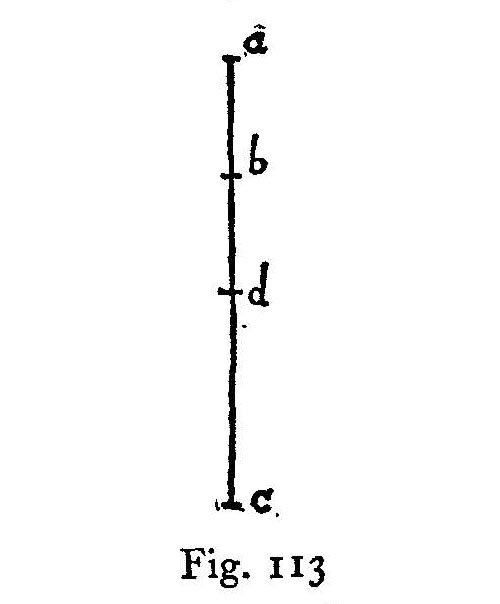
Having agreed arbitrarily upon ab as a measure of these three different quantities, namely, space, time, and momentum, our next task is to find the time required for fall through a given vertical distance ac, also the momentum acquired at the terminal point c, both of which are to be expressed in terms of the time and momentum represented by ab. These two required quantities are obtained by laying off ad, a mean proportional between ab and ac; in other words, the time of fall from a to c is represented by ad on the same scale on which we agreed that the time of fall from a to b should be represented by ab. In like manner we may say that the momentum [impeto o grado di velocità] acquired at c is related to that acquired at b, in the same manner that the line ad is related to ab, since the velocity varies directly as the time, a conclusion, which although employed as a postulate in Proposition III, is here amplified by the Author.
This point being clear and well-established we pass to the consideration of the momentum [impeto] in the case of two compound motions, one of which is compounded of a uniform horizontal and a uniform vertical motion, while the other is compounded of a uniform horizontal and a naturally accelerated vertical motion. If both components are uniform, and one at right angles to the other, we have already seen that the square of the resultant is obtained by adding the squares of the components [p. 257] as will be clear from the following illustration.
Let us imagine a body to move along the vertical ab with a uniform momentum [impeto] of 3, and on reaching b to move toward c with a momentum [velocità ed impeto] of 4, so that during the same time-interval it will traverse 3 cubits along the vertical and 4 along the horizontal. But a particle which moves with the resultant velocity [velocità] will, in the same time, traverse the diagonal ac, whose length is not 7 cubits—the sum of ab (3) and bc (4)—but 5, which is in potenza equal to the sum of 3 and 4, that is, the squares of 3 and 4 when added make 25, which is the square of ac, and is equal to the sum of the squares of ab and bc. Hence ac is represented by the side—or we may say the root—of a square whose area is 25, namely 5.
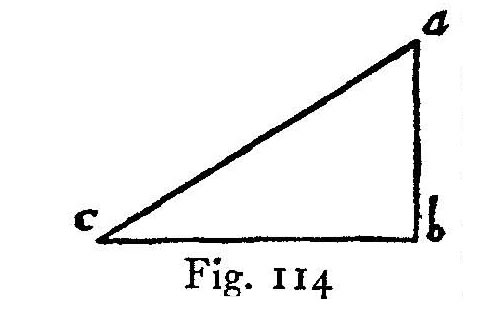
As a fixed and certain rule for obtaining the momentum which results from two uniform momenta, one vertical, the other horizontal, we have therefore the following: take the square of each, add these together, and extract the square root of the sum, which will be the momentum resulting from the two. Thus, in the above example, the body which in virtue of its vertical motion would strike the horizontal plane with a momentum [forza] of 3, would owing to its horizontal motion alone strike at c with a momentum of 4; but if the body strikes with a momentum which is the resultant of these two, its blow will be that of a body moving with a momentum [velocità e forza] of 5; and such a blow will be the same at all points of the diagonal ac, since its components are always the same and never increase or diminish.
Let us now pass to the consideration of a uniform horizontal motion compounded with the vertical motion of a freely falling body starting from rest. It is at once clear that the diagonal which represents the motion compounded of these two is not a straight line, but, as has been demonstrated, a semi-parabola, in which the momentum [impeto] is always increasing because the speed [velocità] of the vertical component is always increasing. Wherefore, to determine the momentum [impeto] at any given point in the parabolic diagonal, it is necessary first to fix upon the uniform horizontal momentum [impeto] and then, treating the body as one falling freely, to find the vertical momentum at the given point; this latter can be determined only by taking into account the duration of fall, a consideration which does not enter into the composition of two uniform motions where the velocities and momenta are always the same; but here where one of the component motions has an initial value of zero and increases its speed [velocità] in direct proportion to the time, it follows that the time must determine the speed [velocità] at the assigned point. It only remains to obtain the momentum resulting from these two components (as in the case of uniform motions) by placing the square of the resultant equal to the sum of the squares of the two components. But here again it is better to illustrate by means of an example.
On the vertical ac lay off any portion ab which we shall employ as a measure of the space traversed by a body falling freely along the perpendicular, likewise as a measure of the time and also of the speed [grado di velocità] or, we may say, of the momenta [impeti]. It is at once clear that if the momentum of a body at b, after having fallen from rest at a, be diverted along the horizontal direction bd, with uniform motion, its speed will be such that, during the time-interval ab, it will traverse a distance which is represented by the line bd and which is twice as great as ab. Now choose a point c, such that bc shall be equal to ab, and through c draw the line ce equal and parallel to bd; through the points b and e draw the parabola bei. And since, during the time-interval ab, the horizontal distance bd or ce, double the length ab, is traversed with the momentum ab, and since during an equal time-interval the vertical distance bc is traversed, the body acquiring at c a momentum represented by the same horizontal, bd, it follows that during the time ab the body will pass from b to e along the parabola be, and will reach e with a momentum compounded of two momenta each equal to ab. And since one of these is horizontal and the other vertical, the square of the resultant momentum is equal to the sum of the squares of these two components, i. e., equal to twice either one of them.
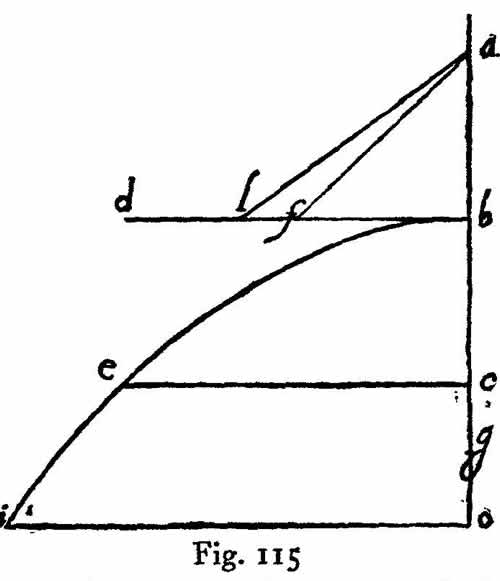
Therefore, if we lay off the distance bf, equal to ba, and draw the diagonal af, it follows that the momentum [impeto e percossa] at e will exceed that of a body at b after having fallen from a, or what is the same thing, will exceed the horizontal momentum [percossa dell’impeto] along bd, in the ratio of af to ab.
Suppose now we choose for the height of fall a distance bo which is not equal to but greater than ab, and suppose that bg represents a mean proportional between ba and bo; then, still retaining ba as a measure of the distance fallen through, from rest at a, to b, also as a measure of the time and of the momentum which the falling body acquires at b, it follows that bg will be the measure of the time and also of the momentum which the body acquires in falling from b to o. Likewise just as the momentum ab during the time ab carried the body a distance along the horizontal equal to twice ab, so now, during the time-interval bg, the body will be carried in a horizontal direction through a distance which is greater in the ratio of bg to ba. Lay off lb equal to bg and draw the diagonal al, from which we have a quantity compounded of two velocities [impeti] one horizontal, the other vertical; these determine the parabola. The horizontal and uniform velocity is that acquired at b in falling from a; the other is that acquired at o, or, we may say, at i, by a body falling through the distance bo, during a time measured by the line bg, which line bg also represents the momentum of the body. And in like manner we may, by taking a mean proportional between the two heights, determine the momentum [impeto] at the extreme end of the parabola where the height is less than the sublimity ab; this mean proportional is to be drawn along the horizontal in place of bf, and also another diagonal in place of af, which diagonal will represent the momentum at the extreme end of the parabola.
To what has hitherto been said concerning the momenta, blows or shocks of projectiles, we must add another very important consideration; to determine the force and energy of the shock [forza ed energia della percossa] it is not sufficient to consider only the speed of the projectiles, but we must also take into account the nature and condition of the target which, in no small degree, determines the efficiency of the blow. First of all it is well known that the target suffers violence from the speed [velocità] of the projectile in proportion as it partly or entirely stops the motion; because if the blow falls upon an object which yields to the impulse [velocità del percuziente] without resistance such a blow will be of no effect; likewise when one attacks his enemy with a spear and overtakes him at an instant when he is fleeing with equal speed there will be no blow but merely a harmless touch. But if the shock falls upon an object which yields only in part then the blow will not have its full effect, but the damage will be in proportion to the excess of the speed of the projectile over that of the receding body; thus, for example, if the shot reaches the target with a speed of 10 while the latter recedes with a speed of 4, the momentum and shock [impeto e percossa] will be represented by 6. Finally the blow will be a maximum, in so far as the projectile is concerned, when the target does not recede at all but if possible completely resists and stops the motion of the projectile. I have said in so far as the projectile is concerned because if the target should approach the projectile the shock of collision [colpo e l’incontro] would be greater in proportion as the sum of the two speeds is greater than that of the projectile alone.
Moreover it is to be observed that the amount of yielding in the target depends not only upon the quality of the material, as regards hardness, whether it be of iron, lead, wool, etc., but also upon its position. If the position is such that the shot strikes it at right angles, the momentum imparted by the blow [impeto del colpo] will be a maximum; but if the motion be oblique, that is to say slanting, the blow will be weaker; and more and more so in proportion to the obliquity; for, no matter how hard the material of the target thus situated, the entire momentum [impeto e moto] of the shot will not be spent and stopped; the projectile will slide by and will, to some extent, continue its motion along the surface of the opposing body.
All that has been said above concerning the amount of momentum in the projectile at the extremity of the parabola must be understood to refer to a blow received on a line at right angles to this parabola or along the tangent to the parabola at the given point; for, even though the motion has two components, one horizontal, the other vertical, neither will the momentum along the horizontal nor that upon a plane perpendicular to the horizontal be a maximum, since each of these will be received obliquely.
Your having mentioned these blows and shocks recalls to my mind a problem, or rather a question, in mechanics of which no author has given a solution or said anything which diminishes my astonishment or even partly relieves my mind.
My difficulty and surprise consist in not being able to see whence and upon what principle is derived the energy and immense force [energia e forza immensa] which makes its appearance in a blow; for instance we see the simple blow of a hammer, weighing not more than 8 or 10 lbs., overcoming resistances which, without a blow, would not yield to the weight of a body producing impetus by pressure alone, even though that body weighed many hundreds of pounds. I would like to discover a method of measuring the force [forza] of such a percussion. I can hardly think it infinite, but incline rather to the view that it has its limit and can be counterbalanced and measured by other forces, such as weights, or by levers or screws or other mechanical instruments which are used to multiply forces in a manner which I satisfactorily understand.
You are not alone in your surprise at this effect or in obscurity as to the cause of this remarkable property. I studied this matter myself for a while in vain; but my confusion merely increased until finally meeting our Academician I received from him great consolation. First he told me that he also had for a long time been groping in the dark; but later he said that, after having spent some thousands of hours in speculating and contemplating thereon, he had arrived at some notions which are far removed from our earlier ideas and which are remarkable for their novelty. And since now I know that you would gladly hear what these novel ideas are I shall not wait for you to ask but promise that, as soon as our discussion of projectiles is completed, I will explain all these fantasies, or if you please, vagaries, as far as I can recall them from the words of our Academician. In the meantime we proceed with the propositions of the author.