Let the motion take place along the line ab, starting from rest at a, and in this line choose any point c. Let ac represent the time, or the measure of the time, required for the body to fall through the space ac; let ac also represent the velocity [impetus seu momentum] at c acquired by a fall through the distance ac. In the line ab select any other point b. The problem now is to determine the velocity at b acquired by a body in falling through the distance ab and to express this in terms of the velocity at c, the measure of which is the length ac. Take as a mean proportional between ac and ab. We shall prove that the velocity at b is to that at c as the length as is to the length ac. Draw the horizontal line cd, having twice the length of ac, and be, having twice the length of ba. It then follows, from the preceding theorems, that a body falling through the distance ac, and turned so as to move along the horizontal cd with a uniform speed equal to that acquired on reaching c will traverse the distance cd in the same interval of time as that required to fall with accelerated motion from a to c. Likewise be will be traversed in the same time as ba. But the time of descent through ab is as; hence the horizontal distance be is also traversed in the time as. Take a point l such that the time as is to the time ac as be is to bl; since the motion along be is uniform, the distance bl, if traversed with the speed [momentum celeritatis] acquired at b, will occupy the time ac; but in this same time-interval, ac, the distance cd is traversed with the speed acquired in c. Now two speeds are to each other as the distances traversed in equal intervals of time. Hence the speed at c is to the speed at b as cd is to bl. But since dc is to be as their halves, namely, as ca is to ba, and since be is to bl as ba is to sa; it follows that dc is to bl as ca is to sa. In other words, the speed at c is to that at b as ca is to sa, that is, as the time of fall through ab.
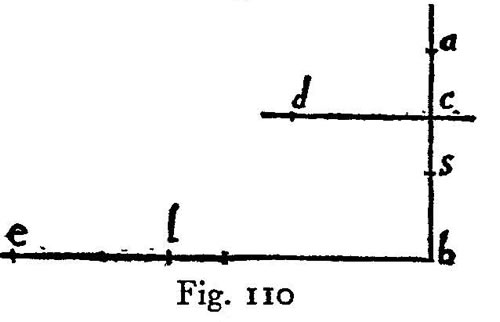
The method of measuring the speed of a body along the direction of its fall is thus clear; the speed is assumed to increase directly as the time.
But before we proceed further, since this discussion is to deal with the motion compounded of a uniform horizontal one and one accelerated vertically downwards—the path of a projectile, namely, a parabola—it is necessary that we define some common standard by which we may estimate the velocity, or momentum [velocitatem, impetum seu momentum] of both motions; and since from the innumerable uniform velocities one only, and that not selected at random, is to be compounded with a velocity acquired by naturally accelerated motion, I can think of no simpler way of selecting and measuring this than to assume another of the same kind. For the sake of clearness, draw the vertical line ac to meet the horizontal line bc. Ac is the height and bc the amplitude of the semi-parabola ab, which is the resultant of the two motions, one that of a body falling from rest at a, through the distance ac, with naturally accelerated motion, the other a uniform motion along the horizontal ad. The speed acquired at c by a fall through the distance ac is determined by the height ac; for the speed of a body falling from the same elevation is always one and the same; but along the horizontal one may give a body an infinite number of uniform speeds. However, in order that I may select one out of this multitude and separate it from the rest in a perfectly definite manner, I will extend the height ca upwards to e just as far as is necessary and will call this distance ae the “sublimity.” Imagine a body to fall from rest at e; it is clear that we may make its terminal speed at a the same as that with which the same body travels along the horizontal line ad; this speed will be such that, in the time of descent along ea, it will describe a horizontal distance twice the length of ea. This preliminary remark seems necessary.
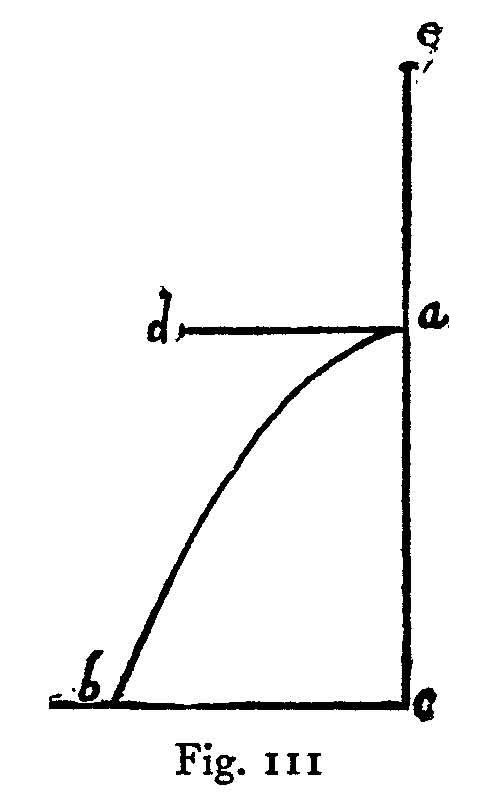
The reader is reminded that above I have called the horizontal line cb the “amplitude” of the semi-parabola ab; the axis ac of this parabola, I have called its “altitude”; but the line ea the fall along which determines the horizontal speed I have called the “sublimity.” These matters having been explained, I proceed with the demonstration.
Allow me, please, to interrupt in order that I may point out the beautiful agreement between this thought of the Author and the views of Plato concerning the origin of the various uniform speeds with which the heavenly bodies revolve. The latter chanced upon the idea that a body could not pass from rest to any given speed and maintain it uniformly except by passing through all the degrees of speed intermediate between the given speed and rest. Plato thought that God, after having created the heavenly bodies, assigned them the proper and uniform speeds with which they were forever to revolve; and that He made them start from rest and move over definite distances under a natural and rectilinear acceleration such as governs the motion of terrestrial bodies. He added that once these bodies had gained their proper and permanent speed, their rectilinear motion was converted into a circular one, the only motion capable of maintaining uniformity, a motion in which the body revolves without either receding from or approaching its desired goal. This conception is truly worthy of Plato; and it is to be all the more highly prized since its underlying principles remained hidden until discovered by our Author who removed from them the mask and poetical dress and set forth the idea in correct historical perspective. In view of the fact that astronomical science furnishes us such complete information concerning the size of the planetary orbits, the distances of these bodies from their centers of revolution, and their velocities, I cannot help thinking that our Author (to whom this idea of Plato was not unknown) had some curiosity to discover whether or not a definite “sublimity” might be assigned to each planet, such that, if it were to start from rest at this particular height and to fall with naturally accelerated motion along a straight line, and were later to change the speed thus acquired into uniform motion, the size of its orbit and its period of revolution would be those actually observed.
I think I remember his having told me that he once made the computation and found a satisfactory correspondence with observation. But he did not wish to speak of it, lest in view of the odium which his many new discoveries had already brought upon him, this might be adding fuel to the fire. But if any one desires such information he can obtain it for himself from the theory set forth in the present treatment.
We now proceed with the matter in hand, which is to prove: