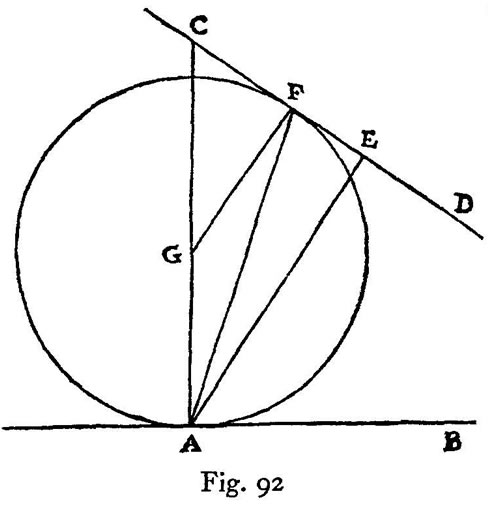
If a straight line is inclined at any angle to the horizontal and if, from any assigned point in the horizontal, a plane of quickest descent is to be drawn to the inclined line, that plane will be the one which bisects the angle contained between two lines drawn from the given point, one perpendicular to the horizontal line, the other perpendicular to the inclined line.
Let CD be a line inclined at any angle to the horizontal AB; and from any assigned point A in the horizontal draw AC perpendicular to AB, and AE perpendicular to CD; draw FA so as to bisect the angle CAE. Then, I say, that of all the planes which can be drawn through the point A, cutting the line CD at any points whatsoever AF is the one of quickest descent [in quo tempore omnium brevissimo fiat descensus]. Draw FG parallel to AE; the alternate angles GFA and FAE will be equal; also the angle EAF is equal to the angle FAG. Therefore the sides GF and GA of the triangle FGA are equal. Accordingly if we describe a circle about G as center, with GA as radius, this circle will pass through the point F, and will touch the horizontal at the point A and the inclined line at F; for GFC is a right angle, since GF and AE are parallel. It is clear therefore that all lines drawn from A to the inclined line, with the single exception of FA, will extend beyond the circumference of the circle, thus requiring more time to traverse any of them than is needed for FA.
q. e. d.
LEMMA
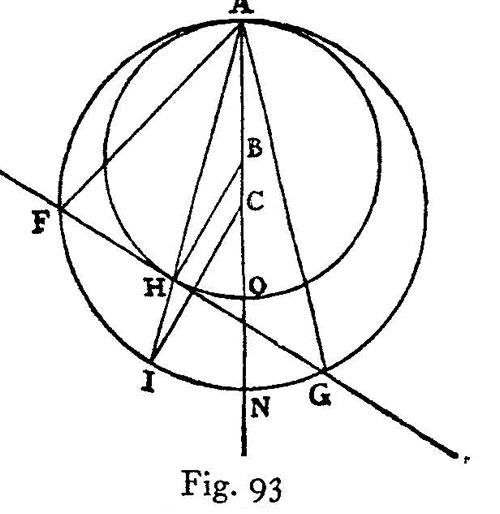
If two circles one lying within the other are in contact, and if any straight line be drawn tangent to the inner circle, cutting the outer circle, and if three lines be drawn from the point at which the circles are in contact to three points on the tangential straight line, namely, the point of tangency on the inner circle and the two points where the straight line extended cuts the outer circle, then these three lines will contain equal angles at the point of contact.
Let the two circles touch each other at the point A, the center of the smaller being at B, the center of the larger at C. Draw the straight line FG touching the inner circle at H, and cutting the outer at the points F and G; also draw the three lines AF, AH, and AG. Then, I say, the angles contained by these lines, FAH and GAH, are equal. Prolong AH to the circumference at I; from the centers of the circles, draw BH and CI; join the centers B and C and extend the line until it reaches the point of contact at A and cuts the circles at the points O and N. But now the lines BH and CI are parallel, because the angles ICN and HBO are equal, each being twice the angle IAN. And since BH, drawn from the center to the point of contact is perpendicular to FG, it follows that CI will also be perpendicular to FG and that the arc FI is equal to the arc IG; consequently the angle FAI is equal to the angle IAG.
q. e. d.