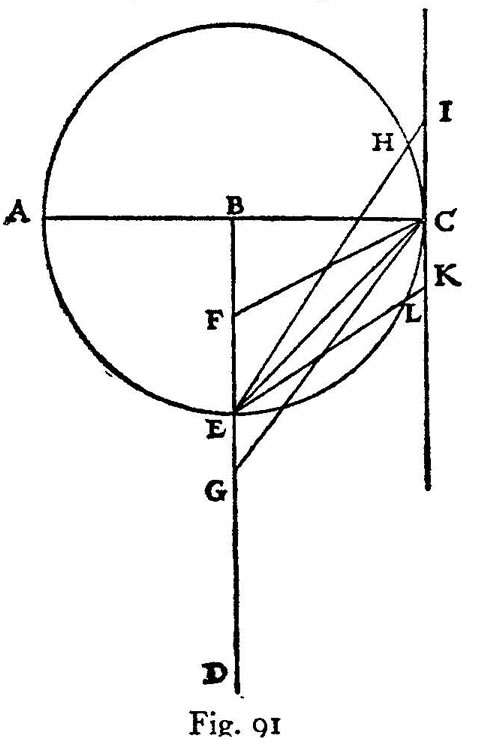
A perpendicular is let fall from any point in a horizontal line; it is required to pass through any other point in this same horizontal line a plane which shall cut the perpendicular and along which a body will descend to the perpendicular in the shortest possible time. Such a plane will cut from the perpendicular a portion equal to the distance of the assumed point in the horizontal from the upper end of the perpendicular.
Let AC be any horizontal line and B any point in it from which is dropped the vertical line BD. Choose any point C in the horizontal line and lay off, on the vertical, the distance BE equal to BC; join C and E. Then, I say, that of all inclined planes that can be passed through C, cutting the perpendicular, CE is that one along which the descent to the perpendicular is accomplished in the shortest time. For, draw the plane CF cutting the vertical above E, and the plane CG cutting the vertical below E; and draw IK, a parallel vertical line, touching at C a circle described with BC as radius. Let EK be drawn parallel to CF, and extended to meet the tangent, after cutting the circle at L. Now it is clear that the time of fall along LE is equal to the time along CE; but the time along KE is greater than along LE; therefore the time along KE is greater than along CE. But the time along KE is equal to the time along CF, since they have the same length and the same slope; and, in like manner, it follows that the planes CG and IE, having the same length and the same slope, will be traversed in equal times. Also, since HE<IE, the time along HE will be less than the time along IE. Therefore also the time along CE (equal to the time along HE), will be shorter than the time along IE.
q. e. d.