The times of descent along planes of the same length but of different inclinations are to each other in the inverse ratio of the square roots of their heights
From a single point B draw the planes BA and BC, having the same length but different inclinations; let AE and CD be horizontal lines drawn to meet the perpendicular BD; and let BE represent the height of the plane AB, and BD the height of BC; also let BI be a mean proportional to BD and BE; then the ratio of BD to BI is equal to the square root of the ratio of BD to BE. Now, I say, the ratio of the times of descent along BA and BC is the ratio of BD to BI; so that the time of descent along BA is related to the height of the other plane BC, namely BD as the time along BC is related to the height BI. Now it must be proved that the time of descent along BA is to that along BC as the length BD is to the length BI.
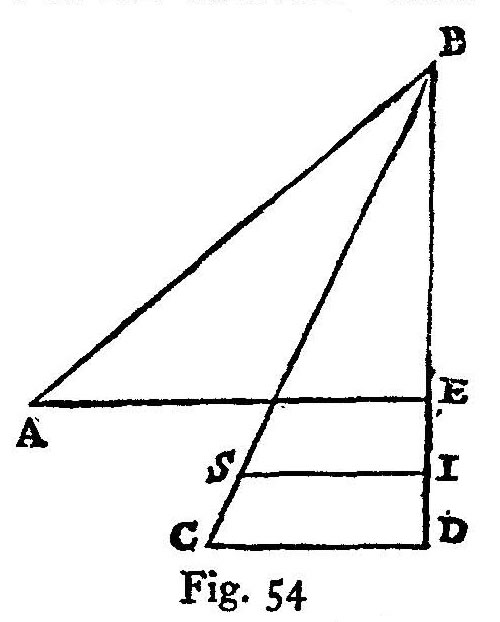
Draw IS parallel to DC; and since it has been shown that the time of fall along BA is to that along the vertical BE as BA is to BE; and also that the time along BE is to that along BD as BE is to BI; and likewise that the time along BD is to that along BC as BD is to BC, or as BI to BS; it follows, ex æquali, that the time along BA is to that along BC as BA to BS, or BC to BS. However, BC is to BS as BD is to BI; hence follows our proposition.