If one and the same body, starting from rest, falls along an inclined plane and also along a vertical, each having the same height, the times of descent will be to each other as the lengths of the inclined plane and the vertical.
Let AC be the inclined plane and AB the perpendicular, each having the same vertical height above the horizontal, namely, BA; then I say, the time of descent of one and the same body along the plane AC bears a ratio to the time of fall along the perpendicular AB, which is the same as the ratio of the length AC to the length AB. Let DG, EI and LF be any lines parallel to the horizontal CB; then it follows from what has preceded that a body starting from A will acquire the same speed at the point G as at D, since in each case the vertical fall is the same; in like manner the speeds at I and E will be the same; so also those at L and F. And in general the speeds at the two extremities of any parallel drawn from any point on AB to the corresponding point on AC will be equal.
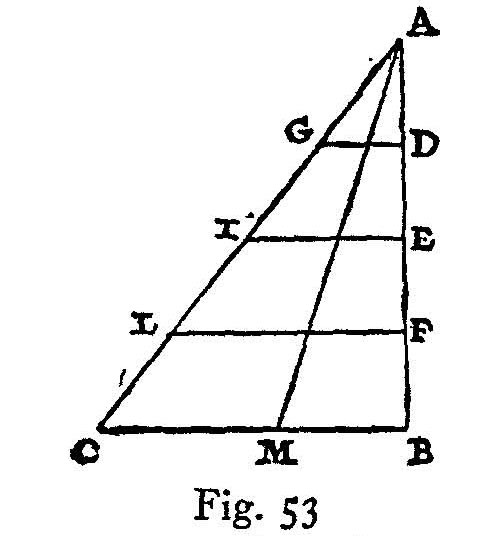
Thus the two distances AC and AB are traversed at the same speed. But it has already been proved that if two distances are traversed by a body moving with equal speeds, then the ratio of the times of descent will be the ratio of the distances themselves; therefore, the time of descent along AC is to that along AB as the length of the plane AC is to the vertical distance AB.
q. e. d.
It seems to me that the above could have been proved clearly and briefly on the basis of a proposition already demonstrated, namely, that the distance traversed in the case of accelerated motion along AC or AB is the same as that covered by a uniform speed whose value is one-half the maximum speed, CB; the two distances AC and AB having been traversed at the same uniform speed it is evident, from Proposition I, that the times of descent will be to each other as the distances.
COROLLARY
Hence we may infer that the times of descent along planes having different inclinations, but the same vertical height stand to one another in the same ratio as the lengths of the planes. For consider any plane AM extending from A to the horizontal CB; then it may be demonstrated in the same manner that the time of descent along AM is to the time along AB as the distance AM is to AB; but since the time along AB is to that along AC as the length AB is to the length AC, it follows, ex æquali, that as AM is to AC so is the time along AM to the time along AC.