Theorem. If from any point (P) without a circle two lines be drawn to it, one of which (PT) is a tangent, and the other (PA) a secant, the rectangle (AP, BP) contained by the segments of the secant is equal to the square of the tangent.
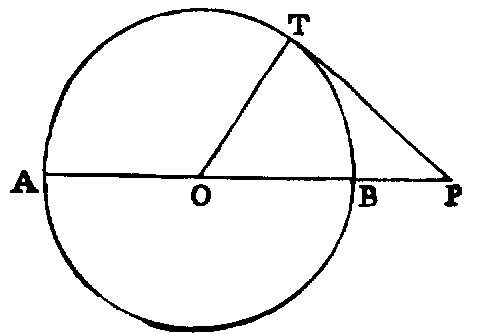
Dem.—1. Let PA pass through the centre O. Join OT. Then because AB is bisected in O and divided externally in P, the rectangle AP.BP + OB2 is equal to OP2 [II. vi.]. But since PT is a tangent, and OT drawn from the centre to the point of contact, the angle OTP is right [xviii.]. Hence OT2 + PT2 is equal to OP2.
Therefore AP.BP + OB2 = OT2 + PT2; but OB2 = OT2. Hence the rectangle AP.BP = PT2.
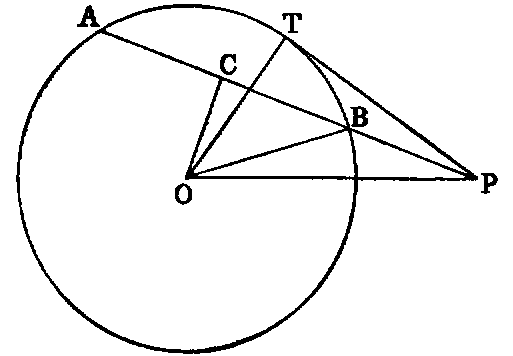
2. If AB does not pass through the centre O, let fall the perpendicular OC on AB. Join OT, OB, OP. Then because OC, a line through the centre, cuts AB, which does not pass through the centre at right angles, it bisects it [iii.]. Hence, since AB is bisected in C and divided externally in P, the rectangle
AP.BP + CB2 = CP2 [II. vi.]; and OC2 = OC2. Hence, adding, since CB2 + OC2 = OB2 [I. xlvii.], and CP2 + OC2 = OP2, we get
rectangle AP.BP + OB2 = OP2;
but OT2 + PT2 = OP2 [I. xlvii.].
Therefore AP.BP + OB2 = OT2 + PT2;
and rejecting the equals OB2 and OT2, we have the rectangle
AP·BP = PT²
The two Propositions xxxv., xxxvi., may be included in one enunciation, as follows:—The rectangle AP.BP contained by the segments of any chord of a given circle passing through a fixed point P, either within or without the circle, is constant. For let O be the centre: join OA, OB, OP. Then OAB is an isosceles triangle, and OP is a line drawn from its vertex to a point P in the base, or base produced. Then the rectangle AP.BP is equal to the difference of the squares of OB and OP, and is therefore constant.
Cor. 1.—If two lines AB, CD produced meet in P, and if the rectangle AP.BP = CP.DP, the points A, B, C, D are concyclic (compare xxxv., Cor. 2).
Cor. 2.—Tangents to two circles from any point in their common chord are equal (compare xvii., Ex. 6).
Cor. 3.—The common chords of any three intersecting circles are concurrent (compare xvii., Ex. 7).
Exercise.
If from the vertex A of a △ ABC, AD be drawn, meeting CB produced in D, and making the angle BAD = ACB, prove DB.DC = DA2.