Theorem. If two chords (AB, CD) of a circle intersect in a point (E) within the circle, the rectangles (AE.EB, CE.ED) contained by the segments are equal.
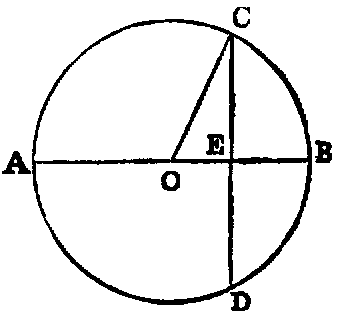
Dem.—1. If the point of intersection be the centre, each rectangle is equal to the square of the radius. Hence they are equal.
2. Let one of the chords AB pass through the centre O, and cut the other chord CD, which does not pass through the centre, at right angles. Join OC. Now because AB passes through the centre, and cuts the other chord CD, which does not pass through the centre at right angles, it bisects it [iii.]. Again, because AB is divided equally in O and unequally in E, the rectangle AE.EB, together with OE2, is equal to OB2—that is, to OC2 [II. v.]; but OC2 is equal to OE2 + EC2 [I. xlvii.] Therefore
AE·EB + OE² = OE² + EC²
Reject OE2, which is common, and we have AE.EB = EC2; but CE2 is equal to the rectangle CE.ED, since CE is equal to ED. Therefore the rectangle AE.EB is equal to the rectangle CE.ED.
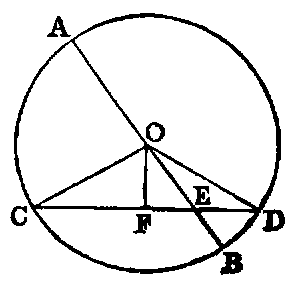
3. Let AB pass through the centre, and cut CD, which does not pass through the centre obliquely. Let O be the centre. Draw OF perpendicular to CD [I. xi.]. Join OC, OD. Then, since CD is cut at right angles by OF, which passes through the centre, it is bisected in F [iii.], and divided unequally in E. Hence
CE.ED + FE2 = FD2 [II. v.], and OF2 = OF2. Hence, adding, since FE2 + OF2 = OE2 [I. xlvii.], and FD2 + OF2 = OD2, we get
CE·ED + OE² = OD² or OB²
Again, since AB is bisected in O and divided unequally in E,
AE.EB + OE2 = OB2 [II. v.]. Therefore CE.ED + OE2 = AE.EB + OE2. Hence CE.ED = AE.EB.
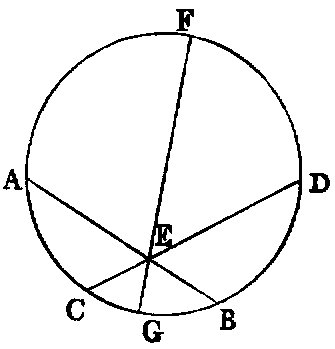
4. Let neither chord pass through the centre. Through the point E, where they intersect, draw the diameter FG. Then by 3, the rectangle FE.EG is equal to the rectangle AE.EB, and also to the rectangle CE.ED. Hence the rectangle AE.EB is equal to the rectangle CE.ED.
Cor. 1.—If a chord of a circle be divided in any point within the circle, the rectangle contained by its segments is equal to the difference between the square of the radius and the square of the line drawn from the centre to the point of section.
Cor. 2.—If the rectangle contained by the segments of one of two intersecting lines be equal to the rectangle contained by the segments of the other, the four extremities are concyclic.
Cor. 3.—If two triangles be equiangular, the rectangle contained by the non-corresponding sides about any two equal angles are equal.
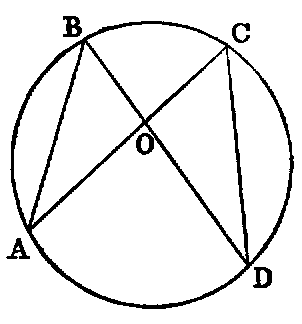
Let ABO, DCO be the equiangular triangles, and let them be placed so that the equal angles at O may be vertically opposite, and that the non-corresponding sides AO, CO may be in one line; then the non-corresponding sides BO, OD shall be in one line. Now, since the angle ABD is equal to ACD, the points A, B, C, D are concyclic [xxi., Cor. 1]. Hence the rectangle AO.OC is equal to the rectangle BO.OD [xxxv.].