Granting the quadratures of curvilinear figures, and supposing that there are given both the law of centripetal force tending to a given centre, and the curve superficies whose axis passes through that centre; it is required to find the trajectory which a body will describe in that superficies, when going off from a given place with a given velocity, and in a given direction in that superficies.
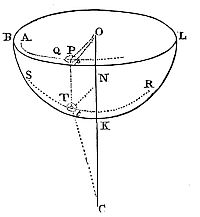
The last construction remaining, let the body T go from the given place S, in the direction of a line given by position, and turn into the trajectory sought STR, whose orthographic projection in the plane BDO is AP. And from the given velocity of the body in the altitude SC, its velocity in any other altitude TC will be also given. With that velocity, in a given moment of time, let the body describe the particle Tt of its trajectory, and let Pp be the projection of that particle described in the plane AOP. Join Op, and a little circle being described upon the curve superficies about the centre T with the interval Tt let the projection of that little circle in the plane AOP be the ellipsis pQ. And because the magnitude of that little circle Tt, and TN or PO its distance from the axis CO is also given, the ellipsis pQ will be given both in kind and magnitude, as also its position to the right line PO. And since the area POp is proportional to the time, and therefore given because the time is given, the angle POp will be given. And thence will be given p the common intersection of the ellipsis and the right line Op, together with the angle OPp, in which the projection APp of the trajectory cuts the line OP. But from thence (by conferring Prop. XLI, with its 2d Cor.) the manner of determining the curve APp easily appears. Then from the several points P of that projection erecting to the plane AOP, the perpendiculars PT meeting the curve superficies in T, there will be given the several points T of the trajectory. Q.E.I.