Granting the quadratures of curvilinear figures, it is required to find the times in which bodies by means of any centripetal force will descend or ascend in any curve lines described in a plane passing through the centre of force.
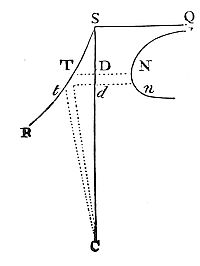
Let the body descend from any place S, and move in any curve STtR given in a plane passing through the centre of force C. Join CS, and let it be divided into innumerable equal parts, and let Dd be one of those parts. From the centre C, with the intervals CD, Cd, let the circles DT, dt be described, meeting the curve line STtR in T and t. And because the law of centripetal force is given, and also the altitude CS from which the body at first fell, there will be given the velocity of the body in any other altitude CT (by Prop. XXXIX). But the time in which the body describes the lineola Tt is as the length of that lineola, that is, as the secant of the angle tTC directly, and the velocity inversely. Let the ordinate DN, proportional to this time, be made perpendicular to the right line CS at the point D, and because Dd is given, the rectangle Dd × DN, that is, the area DNnd, will be proportional to the same time. Therefore if PNn be a curve line in which the point N is perpetually found, and its asymptote be the right line SQ standing upon the line CS at right angles, the area SQPND will be proportional to the time in which the body in its descent hath described the line ST; and therefore that area being found, the time is also given. Q.E.I.