To define the velocities of the pendulums in the several places, and the times in which both the entire oscillations, and the several parts of them are performed.
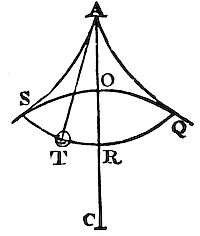
About any centre G, with the interval GH equal to the arc of the cycloid RS, describe a semi-circle HKM bisected by the semi-diameter GK. And if a centripetal force proportional to the distance of the places from the centre tend to the centre G, and it be in the perimeter HIK equal to the centripetal force in the perimeter of the globe QOS tending towards its centre, and at the same time that the pendulum T is let fall from the highest place S, a body, as L, is let fall from H to G; then because the forces which act upon the bodies are equal at the beginning, and always proportional to the spaces to be described TR, LG, and therefore if TR and LG are equal, are also equal in the places T and L, it is plain that those bodies describe at the beginning equal spaces ST, HL, and therefore are still acted upon equally, and continue to describe equal spaces.
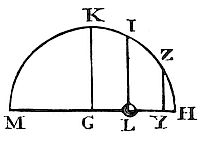
Therefore by Prop. XXXVIII, the time in which the body describes the arc ST is to the time of one oscillation, as the arc HI the time in which the body H arrives at L, to the semi-periphery HKM, the time in which the body H will come to M. And the velocity of the pendulous body in the place T is to its velocity in the lowest place R, that is, the velocity of the body H in the place L to its velocity in the place G, or the momentary increment of the line HL to the momentary increment of the line HG (the arcs HI, HK increasing with an equable flux) as the ordinate LI to the radius GK, or as √SR²−TR² to SR. Hence, since in unequal oscillations there are described in equal time arcs proportional to the entire arcs of the oscillations, there are obtained from the times given, both the velocities and the arcs described in all the oscillations universally. Which was first required.
Let now any pendulous bodies oscillate in different cycloids described within different globes, whose absolute forces are also different; and if the absolute force of any globe QOS be called V, the accelerative force with which the pendulum is acted on in the circumference of this globe, when it begins to move directly towards its centre, will be as the distance of the pendulous body from that centre and the absolute force of the globe conjunctly, that is, as CO × V. Therefore the lineola HY, which is as this accelerated force CO × V, will be described in a given time; and if there be erected the perpendicular YZ meeting the circumference in Z, the nascent arc HZ will denote that given time. But that nascent arc HZ is in the subduplicate ratio of the rectangle GHY, and therefore as √GH × CO × V. Whence the time of an entire oscillation in the cycloid QRS (it being as the semi-periphery HKM, which denotes that entire oscillation, directly; and as the arc HZ which in like manner denotes a given time inversely) will be as GH directly and √GH × CO × V inversely; that is, because GH and SR are equal, as √SR/(CO × V), or (by Cor. Prop. L.) as √AR/(AC × V). Therefore the oscillations in all globes and cycloids, performed with what absolute forces soever, are in a ratio compounded of the subduplicate ratio of the length of the string directly, and the subduplicate ratio of the distance between the point of suspension and the centre of the globe inversely, and the subduplicate ratio of the absolute force of the globe inversely also. Q.E.I.
COR. 1. Hence also the times of oscillating, falling, and revolving bodies may be compared among themselves. For if the diameter of the wheel with which the cycloid is described within the globe is supposed equal to the semi-diameter of the globe, the cycloid will become a right line passing through the centre of the globe, and the oscillation will be changed into a descent and subsequent ascent in that right line. Whence there is given both the time of the descent from any place to the centre, and the time equal to it in which the body revolving uniformly about the centre of the globe at any distance describes an arc of a quadrant. For this time (by Case 2) is to the time of half the oscillation in any cycloid QRS as 1 to √AR/AC.
COR. 2. Hence also follow what Sir Christopher Wren and M. Huygens have discovered concerning the vulgar cycloid. For if the diameter of the globe be infinitely increased, its spherical superficies will be changed into a plane, and the centripetal force will act uniformly in the direction of lines perpendicular to that plane, and this cycloid of our's will become the same with the common cycloid. But in that case the length of the arc of the cycloid between that plane and the describing point will become equal to four times the versed sine of half the arc of the wheel between the same plane and the describing point, as was discovered by Sir Christopher Wren. And a pendulum between two such cycloids will oscillate in a similar and equal cycloid in equal times, as M. Huygens demonstrated. The descent of heavy bodies also in the time of one oscillation will be the same as M. Huygens exhibited.
The propositions here demonstrated are adapted to the true constitution of the Earth, in so far as wheels moving in any of its great circles will describe, by the motions of nails fixed in their perimeters, cycloids without the globe; and pendulums, in mines and deep caverns of the Earth, must oscillate in cycloids within the globe, that those oscillations may be performed in equal times. For gravity (as will be shewn in the third book) decreases in its progress from the superficies of the Earth; upwards in a duplicate ratio of the distances from the centre of the Earth; downwards in a simple ratio of the same.