If a wheel stand upon the inside of a concave globe at right angles thereto, and revolving about its own axis go forward in one of the great circles of the globe, the length of the curvilinear path which any point, given in the perimeter of the wheel, hath described since it touched the globe, will be to the double of the versed sine of half the arc which in all that time has touched the globe in passing over it, as the difference of the diameters of the globe and the wheel to the semi-diameter of the globe.
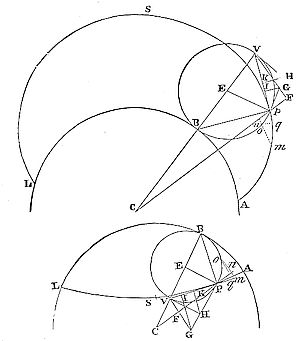
Let ABL be the globe, C its centre, BPV the wheel insisting thereon, E the centre of the wheel, B the point of contact, and P the given point in the perimeter of the wheel. Imagine this wheel to proceed in the great circle ABL from A through B towards L, and in its progress to revolve in such a manner that the arcs AB, PB may be always equal one to the other, and the given point P in the perimeter of the wheel may describe in the mean time the curvilinear path AP. Let AP be the whole curvilinear path described since the wheel touched the globe in A, and the length of this path AP will be to twice the versed sine of the arc ^(1/2)PB as 2CE to CB. For let the right line CE (produced if need be) meet the wheel in V, and join CP, BP, EP, VP; produce CP, and let fall thereon the perpendicular VF. Let PH, VH, meeting in H, touch the circle in P and V, and let PH cut VF in G, and to VP let fall the perpendiculars GI, HK. From the centre C with any interval let there be described the circle nom, cutting the right line CP in n, the perimeter of the wheel BP in o, and the curvilinear path AP in m; and from the centre V with the interval Vo let there be described a circle cutting VP produced in q.
Because the wheel in its progress always revolves about the point of contact B, it is manifest that the right line BP is perpendicular to that curve line AP which the point P of the wheel describes, and therefore that the right line VP will touch this curve in the point P. Let the radius of the circle nom be gradually increased or diminished so that at last it become equal to the distance CP; and by reason of the similitude of the evanescent figure Pnomq, and the figure PFGVI, the ultimate ratio of the evanescent lineolæ Pm, Pn, Po, Pq, that is, the ratio of the momentary mutations of the curve AP, the right line CP, the circular arc BP, and the right line VP, will be the same as of the lines PV, PF, PG, PI, respectively. But since VF is perpendicular to CF, and VH to CV, and therefore the angles HVG, VCF equal; and the angle VHG (because the angles of the quadrilateral figure HVEP are right in V and P) is equal to the angle CEP, the triangles VHG, CEP will be similar; and thence it will come to pass that as EP is to CE so is HG to HV or HP, and so KI to KP, and by composition or division as CB to CE so is PI to PK, and doubling the consequents as CB to 2CE so PI to PV, and so is Pq to Pm. Therefore the decrement of the line VP, that is, the increment of the line BV - VP to the increment of the curve line AP is in a given ratio of CB to 2CE, and therefore (by Cor. Lem. IV) the lengths BV - VP and AP, generated by those increments, are in the same ratio. But if BV be radius, VP is the cosine of the angle BVP or ^(1/2)BEP, and therefore BV - VP is the versed sine of the same angle, and therefore in this wheel, whose radius is ^(1/2)BV, BV - VP will be double the versed sine of the arc ^(1/2)PB. Therefore AP is to double the versed sine of the arc ^(1/2)PB as 2CE to CB. Q.E.D.
The line AP in the former of these Propositions we shall name the cycloid without the globe, the other in the latter Proposition the cycloid within the globe, for distinction sake.
COR. 1. Hence if there be described the entire cycloid ASL, and the same be bisected in S, the length of the part PS will be to the length PV (which is the double of the sine of the angle VBP, when EB is radius) as 2CE to CB, and therefore in a given ratio.
COR. 2. And the length of the semi-perimeter of the cycloid AS will be equal to a right line which is to the diameter of the wheel BV as 2CE to CB.