The things above found being supposed, I say, that the velocity of a falling body in any place C is to the velocity of a body, describing a circle about the centre B at the distance BC, in the subduplicate ratio of AC, the distance of the body from the remoter vertex A of the circle or rectangular hyperbola, to ^(1/2)AB, the principal semi-diameter of the figure.
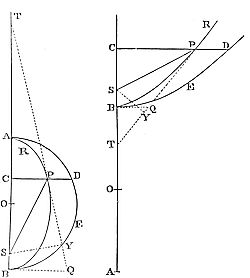
Let AB, the common diameter of both figures RPB, DEB, be bisected in O; and draw the right line PT that may touch the figure RPB in P, and likewise cut that common diameter AB (produced, if need be) in T; and let SY be perpendicular to this line, and BQ to this diameter, and suppose the latus rectum of the figure RPB to be L. From Cor. 9, Prop. XVI, it is manifest that the velocity of a body, moving in the line RPB about the centre S, in any place P, is to the velocity of a body describing a circle about the same centre, at the distance SP, in the subduplicate ratio of the rectangle ^(1/2)L × SP to SY2. For by the properties of the conic sections ACB is to CP2 as 2AO to L, and therefore (2CP² × AO)/ACB is equal to L. Therefore those velocities are to each other in the subduplicate ratio of (CP² × AO × SP)/ACB to SY2. Moreover, by the properties of the conic sections, CO is to BO as BO to TO and (by composition or division) as CB to BT. Whence (by division or composition) BO - or + CO will be to BO as CT to BT, that is, AC will be to AO as CP to BQ; and therefore (CP² × AO × SP)/ACB is equal to (BQ² × AC × SP)/(AO × BC). Now suppose CP, the breadth of the figure RPB, to be diminished in infinitum, so as the point P may come to coincide with the point C, and the point S with the point B, and the line SP with the line BC, and the line SY with the line BQ; and the velocity of the body now descending perpendicularly in the line CB will be to the velocity of a body describing a circle about the centre B, at the distance BC, in the subduplicate ratio of (BQ² × AC × SP)/(AO × BC) to SY2, that is (neglecting the ratios of equality of SP to BC, and BQ2 to SY2), in the subduplicate ratio of AC to AO, or ^(1/2)AB. Q.E.D.
COR. 1. When the points B and S come to coincide, TC will become to TS as AC to AO.
COR. 2. A body revolving in any circle at a given distance from the centre, by its motion converted upwards, will ascend to double its distance from the centre.