To find at any assigned time the place of a body moving in a given parabolic trajectory.
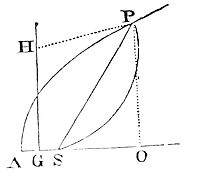
Let S be the focus, and A the principal vertex of the parabola; and suppose 4AS × M equal to the parabolic area to be cut off APS, which either was described by the radius SP, since the body's departure from the vertex, or is to be described thereby before its arrival there. Now the quantity of that area to be cut off is known from the time which is proportional to it. Bisect AS in G, and erect the perpendicular GH equal to 3M, and a circle described about the centre H, with the interval HS, will cut the parabola in the place P required. For letting fall PO perpendicular on the axis, and drawing PH, there will be AG²+GH² (= HP² = AO−AG|²+PO−GH|² ) = AO²+PO²−2GAO−2GH+PO+AG²+GH².
Whence 2GH × PO( = AO²+PO²−2GAO) = AO²+¾PO². For AO² write AO × PO²/4AS; then dividing all the terms by 3PO, and multiplying them by 2AS, we shall have 4/3GH × AS( = 1/6AO × PO+^(1/2)AS × PO = (AO+3AS)/6 × PO = (4AO−3SO)/6 × PO = to the area APO−SPO| = to the area APS. But GH was 3M, and therefore 4/3GH × AS is 4AS × M. Wherefore the area cut off APS is equal to the area that was to be cut off 4AS × M. Q.E.D.
COR. 1. Hence GH is to AS as the time in which the body described the arc AP to the time in which the body described the arc between the vertex A and the perpendicular erected from the focus S upon the axis.
COR. 2. And supposing a circle ASP perpetually to pass through the moving body P, the velocity of the point H is to the velocity which the body had in the vertex A as 3 to 8; and therefore in the same ratio is the line GH to the right line which the body, in the time of its moving from A to P, would describe with that velocity which it had in the vertex A.
COR. 3. Hence, also, on the other hand, the time may be found in which the body has described any assigned arc AP. Join AP, and on its middle point erect a perpendicular meeting the right line GH in H.