If four sides of a parallelogram indefinitely produced touch any conic section, and are cut by a fifth tangent; I say, that, taking those segments of any two conterminous sides that terminate in opposite angles of the parallelogram, either segment is to the side from which it is cut off as that part of the other conterminous side which is intercepted between the point of contact and the third side is to the other segment.
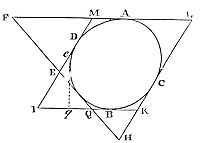
Let the four sides ML, IK, KL, MI, of the parallelogram MLIK touch the conic section in A, B, C, D; and let the fifth tangent FQ cut those sides in F, Q, H, and E; and taking the segments ME, KQ of the sides MI, KI, or the segments KH, MF of the sides KL, ML, I say, that ME is to MI as BK to KQ; and KH to KL as AM to MF. For, by Cor. 1 of the preceding Lemma, ME is to EI as (AM or) BK to BQ; and, by composition, ME is to MI as BK to KQ. Q.E.D. Also KH is to HL as (BK or) AM to AF; and by division, KH to KL as AM to MF. Q.E.D.
COR. 1. Hence if a parallelogram IKLM described about a given conic section is given, the rectangle KQ × ME, as also the rectangle KH × MF equal thereto, will be given. For, by reason of the similar triangles KQH MFE, those rectangles are equal.
COR. 2. And if a sixth tangent eq is drawn meeting the tangents KI, MI in q and e, the rectangle KQ × ME will be equal to the rectangle Kq × Me, and KQ will be to Me as Kq to ME, and by division as Qq to Ee.
COR. 3. Hence, also, if Eq, eQ, are joined and bisected, and a right line is drawn through the points of bisection, this right line will pass through the centre of the conic section. For since Qq is to Ee as KQ to Me, the same right line will pass through the middle of all the lines Eq, eQ, MK (by Lem. XXIII), and the middle point of the right line MK is the centre of the section.