To describe a trajectory that shall pass through two given points, and touch three right lines given by position.
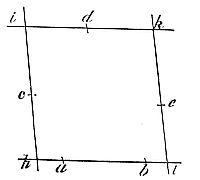
Through the concourse of any two of the tangents one with the other, and the concourse of the third tangent with the right line which passes through the two given points, draw an indefinite right line; and, taking this line for the first ordinate radius, transform the figure by the preceding Lemma into a new figure. In this figure those two tangents will become parallel to each other, and the third tangent will be parallel to the right line that passes through the two given points. Suppose hi, kl to be those two parallel tangents, ik the third tangent, and hl a right line parallel thereto, passing through those points a, b, through which the conic section ought to pass in this new figure; and completing the parallelogram hikl, let the right lines hi, ik, kl be so cut in c, d, e, that hc may be to the square root of the rectangle ahb, ic, to id, and ke to kd, as the sum of the right lines hi and kl is to the sum of the three lines, the first whereof is the right line ik, and the other two are the square roots of the rectangles ahb and alb; and c, d, e, will be the points of contact. For by the properties of the conic sections, hc2 to the rectangle ahb, and ic2 to id2, and ke2 to kd2, and el2 to the rectangle alb, are all in the same ratio; and therefore hc to the square root of ahb, ic to id, ke to kd, and el to the square root of alb, are in the subduplicate of that ratio; and by composition, in the given ratio of the sum of all the antecedents hi + kl, to the sum of all the consequents √aℎb+ik+√alb. Wherefore from that given ratio we have the points of contact c, d, e, in the new figure. By the inverted operations of the last Lemma, let those points be transferred into the first figure, and the trajectory will be there described by Prob. XIV. Q.E.F. But according as the points a, b, fall between the points h, l, or without them, the points c, d, e, must be taken either between the points, h, i, k, l, or without them. If one of the points a, b, falls between the points h, i, and the other without the points h, l, the Problem is impossible.