To describe a trajectory that shall pass through four given points, and touch a right line given by position.
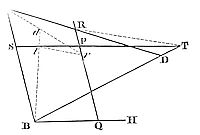
CASE 1. Suppose that HB is the given tangent, B the point of contact, and C, L, P, the three other given points. Join BC, and draw PS parallel to BH, and PQ parallel to BC; complete the parallelogram BSPQ. Draw BD cutting SP in T, and CD cutting PQ in R. Lastly, draw any line tr parallel to TR, cutting off from PQ, PS, the segments Pr, Pt proportional to PR, PT respectively; and draw Cr, Bt their point of concourse d will (by Lem. XX) always fall on the trajectory to be described.
The same otherwise.
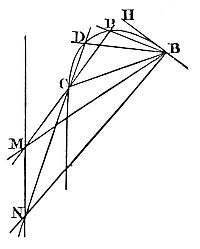
Let the angle CBH of a given magnitude revolve about the pole B, as also the rectilinear radius BC, both ways produced, about the pole C. Mark the points M, N, on which the leg BC of the angle cuts that radius when BH, the other leg thereof, meets the same radius in the points P and D. Then drawing the indefinite line MN, let that radius CP or CD and the leg BC of the angle perpetually meet in this line; and the point of concourse of the other leg BH with the radius will delineate the trajectory required.
For if in the constructions of the preceding Problem the point A comes to a coincidence with the point B, the lines CA and CB will coincide, and the line AB, in its last situation, will become the tangent BH; and therefore the constructions there set down will become the same with the constructions here described. Wherefore the concourse of the leg BH with the radius will describe a conic section passing through the points C, D, P, and touching the line BH in the point B. Q.E.F.
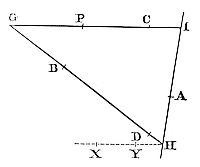
CASE 2. Suppose the four points B, C, D, P, given, being situated without the tangent HI. Join each two by the lines BD, CP meeting in G, and cutting the tangent in H and I. Cut the tangent in A in such manner that HA may be to IA as the rectangle under a mean proportional between CG and GP, and a mean proportional between BH and HD is to a rectangle under a mean proportional between GD and GB, and a mean proportional between PI and IC, and A will be the point of contact. For if HX, a parallel to the right line PI, cuts the trajectory in any points X and Y, the point A (by the properties of the conic sections) will come to be so placed, that HA2 will become to AI2 in a ratio that is compounded out of the ratio of the rectangle XHY to the rectangle BHD, or of the rectangle CGP to the rectangle DGB; and the ratio of the rectangle BHD to the rectangle PIC. But after the point of contact A is found, the trajectory will be described as in the first Case. Q.E.F. But the point A may be taken either between or without the points H and I, upon which account a twofold trajectory may be described.