From three given points to draw to a fourth point that is not given three right lines whose differences shall be either given, or none at all.
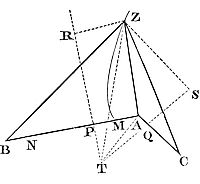
CASE 1. Let the given points be A, B, C, and Z the fourth point which we are to find; because of the given difference of the lines AZ, BZ, the locus of the point Z will be an hyperbola whose foci are A and B, and whose principal axis is the given difference. Let that axis be MN. Taking PM to MA as MN is to AB, erect PR perpendicular to AB, and let fall ZR perpendicular to PR; then from the nature of the hyperbola, ZR will be to AZ as MN is to AB. And by the like argument, the locus of the point Z will be another hyperbola, whose foci are A, C, and whose principal axis is the difference between AZ and CZ; and QS a perpendicular on AC may be drawn, to which (QS) if from any point Z of this hyperbola a perpendicular ZS is let fall (this ZS), shall be to AZ as the difference between AZ and CZ is to AC. Wherefore the ratios of ZR and ZS to AZ are given, and consequently the ratio of ZR to ZS one to the other; and therefore if the right lines RP, SQ, meet in T, and TZ and TA are drawn, the figure TRZS will be given in specie, and the right line TZ, in which the point Z is somewhere placed, will be given in position. There will be given also the right line TA, and the angle ATZ; and because the ratios of AZ and TZ to ZS are given, their ratio to each other is given also; and thence will be given likewise the triangle ATZ, whose vertex is the point Z. Q.E.I.
CASE 2. If two of the three lines, for example AZ and BZ, are equal, draw the right line TZ so as to bisect the right line AB; then find the triangle ATZ as above. Q.E.I.
CASE 3. If all the three are equal, the point Z will be placed in the centre of a circle that passes through the points A, B, C. Q.E.I.
This problematic Lemma is likewise solved in Apollonius's Book of Tactions restored by Vieta.