Suppose a body to move in an hyperbola; it is required to find the law of the centripetal force tending to the focus of that figure.
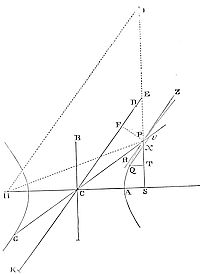
Let CA, CB be the semi-axes of the hyperbola; PG, KD other conjugate diameters; PF a perpendicular to the diameter KD; and Qv an ordinate to the diameter GP. Draw SP cutting the diameter DK in E, and the ordinate Qv in x, and complete the parallelogram QRPx. It is evident that EP is equal to the semi-transverse axis AC; for drawing HI, from the other focus H of the hyperbola, parallel to EC, because CS, CH are equal, ES, EI will be also equal; so that EP is the half difference of PS, PI; that is (because of the parallels IH, PR, and the equal angles IPR, HPZ), of PS, PH, the difference of which is equal to the whole axis 2AC. Draw QT perpendicular to SP; and putting L for the principal latus rectum of the hyperbola (that is, for 2BC²/AC ), we shall have L × QR to L × Pv as QR to Pv, or Px to Pv, that is (because of the similar triangles Pxv, PEC), as PE to PC, or AC to PC. And L × Pv will be to Gv × Pv as L to Gv; and (by the properties of the conic sections) the rectangle GvP is to Qv2 as PC2 to CD2; and by (Cor. 2, Lem. VII.), Qv2 to Qx2, the points Q and P coinciding, becomes a ratio of equality; and Qx2 or Qv2 is to QT2 as EP2 to PF2, that is, as CA2 to PF2, or (by Lem. XII.) as CD2 to CB2: and, compounding all those ratios together, we shall have L × QR to QT2 as AC × L × PC2 × CD2, or 2CB2 × PC2 × CD2 to PC × Gv × CD2 × CB2, or as 2PC to Gv. But the points P and Q coinciding, 2PC and Gv are equal. And therefore the quantities L × QR and QT2, proportional to them, will be also equal. Let those equals be drawn into SP²/QR, and we shall have L × SP2 equal to (SP² × QR)/QT². And therefore (by Cor. 1 and 5, Prop. VI.) the centripetal force is reciprocally as L × SP2, that is, reciprocally in the duplicate ratio of the distance SP. Q.E.I.
The same otherwise.
Find out the force tending from the centre C of the hyperbola. This will be proportional to the distance CP. But from thence (by Cor. 3, Prop. VII.) the force tending to the focus S will be as PE³/SP², that is, because PE is given reciprocally as SP2. Q.E.I.
And the same way may it be demonstrated, that the body having its centripetal changed into a centrifugal force, will move in the conjugate hyperbola.