If a body revolves in an ellipsis; it is proposed to find the law of the centripetal force tending to the centre of the ellipsis.
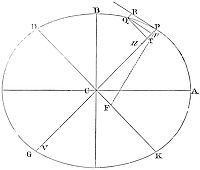
Suppose CA, CB to be semi-axes of the ellipsis; GP, DK, conjugate diameters; PF, QT perpendiculars to those diameters; Qv an ordinate to the diameter GP; and if the parallelogram QvPR be completed, then (by the properties of the conic sections) the rectangle PvG will be to Qv² as PC² to CD²; and (because of the similar triangles QvT, PCF), Qv² to QT² as PC² to PF²; and, by composition, the ratio of PvG to QT² is compounded of the ratio of PC² to CD², and of the ratio of PC² to PF², that is, vG to QT²/Pv as PC² to (CD² × PF²)/PC². Put QR for Pv, and (by Lem. XII) BC × CA for CD × PF; also (the points P and Q coinciding) 2PC for vG; and multiplying the extremes and means together, we shall have (QT² × PC²)/QR equal to (2BC² × CA²)/PC. Therefore (by Cor. 5, Prop. VI), the centripetal force is reciprocally as (2BC² × CA²)/PC; that is (because 2BC² × CA² is given), reciprocally as 1/PC; that is, directly as the distance PC. Q.E.I.
The same otherwise.
In the right line PG on the other side of the point T, take the point u so that Tu may be equal to Tv; then take uV, such as shall be to vG as DC² to PC². And because Qv² is to PvG as DC² to PC² (by the conic sections), we shall have Qv² = Pv × uV. Add the rectangle uPv to both sides, and the square of the chord of the arc PQ will be equal to the rectangle VPv; and therefore a circle which touches the conic section in P, and passes through the point Q, will pass also through the point V. Now let the points P and Q meet, and the ratio of uV to vG, which is the same with the ratio of DC² to PC², will become the ratio of PV to PG, or PV to 2PC; and therefore PV will be equal to 2DC²/PC. And therefore the force by which the body P revolves in the ellipsis will be reciprocally as 2DC²/PC × PF² (by Cor. 3, Prop. VI); that is (because 2DC² × PF² is given) directly as PC. Q.E.I.
COR. 1. And therefore the force is as the distance of the body from the centre of the ellipsis; and, vice versa, if the force is as the distance, the body will move in an ellipsis whose centre coincides with the centre of force, or perhaps in a circle into which the ellipsis may degenerate.
COR. 2. And the periodic times of the revolutions made in all ellipses whatsoever about the same centre will be equal. For those times in similar ellipses will be equal (by Corol. 3 and 8, Prop. IV); but in ellipses that have their greater axis common, they are one to another as the whole areas of the ellipses directly, and the parts of the areas described in the same time inversely; that is, as the lesser axes directly, and the velocities of the bodies in their principal vertices inversely; that is, as those lesser axes directly, and the ordinates to the same point of the common axes inversely; and therefore (because of the equality of the direct and inverse ratios) in the ratio of equality.
SCHOLIUM.
If the ellipsis, by having its centre removed to an infinite distance, degenerates into a parabola, the body will move in this parabola; and the force, now tending to a centre infinitely remote, will become equable. Which is Galileo's theorem. And if the parabolic section of the cone (by changing the inclination of the cutting plane to the cone) degenerates into an hyperbola, the body will move in the perimeter of this hyperbola, having its centripetal force changed into a centrifugal force. And in like manner as in the circle, or in the ellipsis, if the forces are directed to the centre of the figure placed in the abscissa, those forces by increasing or diminishing the ordinates in any given ratio, or even by changing the angle of the inclination of the ordinates to the abscissa, are always augmented or diminished in the ratio of the distances from the centre; provided the periodic times remain equal; so also in all figures whatsoever, if the ordinates are augmented or diminished in any given ratio, or their inclination is any way changed, the periodic time remaining the same, the forces directed to any centre placed in the abscissa are in the several ordinates augmented or diminished in the ratio of the distances from the centre.