Let ABC be a parabola, having its focus in S. By the chord AC bisected in I cut off the segment ABCI, whose diameter is I𝜇 and vertex 𝜇. In I𝜇 produced take 𝜇O equal to one half of I𝜇. Join OS, and produce it to 𝜉 as S𝜉 may be equal to 2SO. Now, supposing a comet to revolve in the arc CBA, draw 𝜉B, cutting AC in E; I say, the point E will cut off from the chord AC the segment AE, nearly proportional to the time.
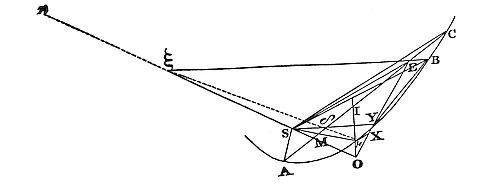
For if we join EO, cutting the parabolic arc ABC in Y, and draw muX touching the same arc in the vertex mu, and meeting EO in X, the curvilinear area AEX𝜇A will be to the curvilinear area ACY𝜇A as AE to AC; and, therefore, since the triangle ASE is to the triangle ASC in the same proportion, the whole area ASEX𝜇A will be to the whole area ASCY𝜇A as AE to AC. But, because 𝜉O is to SO as 3 to 1, and EO to XO in the same proportion, SX will be parallel to EB; and, therefore, joining BX, the triangle SEB will be equal to the triangle XEB. Wherefore if to the area ASEX𝜇A we add the triangle EXB, and from the sum subduct the triangle SEB, there will remain the area ASBX𝜇A, equal to the area ASEX𝜇A; and therefore in proportion to the area ASCY𝜇A as AE to AC. But the area ASBY𝜇A is nearly equal to the area ASBX𝜇A; and this area ASBY𝜇A is to the area ASCY𝜇A as the time of description of the arc AB to the time of description of the whole arc AC; and, therefore, AE is to AC nearly in the proportion of the times. Q.E.D.
COR. When the point B falls upon the vertex 𝜇 of the parabola, AE is to AC accurately in the proportion of the times.
SCHOLIUM.
If we join 𝜇𝜉 cutting AC in 𝛿; and in it take 𝜉n in proportion to 𝜇B as 27MI to 16M𝜇, and draw Bn, this Bn will cut the chord AC, in the proportion of the times, more accurately than before; but the point n is to be taken beyond or on this side the point 𝜉, according as the point B is more or less distant from the principal vertex of the parabola than the point 𝜇.