To find a curve line of the parabolic kind which shall pass through any given number of points.
Let those points be A, B, C, D, E, F, &c., and from the same to any right line HN, given in position, let fall as many perpendiculars AH, BI, CK, DL, EM, FN, &c.
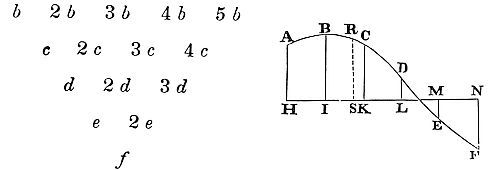
CASE 1. If HI, IK, KL, &c., the intervals of the points H, I, K, L, M, N, &c., are equal, take b, 2b, 3b, 4b, 5b, &c., the first differences of the perpendiculars AH, BI, CK, &c.; their second differences c, 2c, 3c, 4c, &c.; their third, d, 2d, 3d, &c., that is to say, so as AH - BI may be = b, BI - CK = 2b, CK - DL = 3b, DL + EM = 4b, - EM + FN = 5b, &c.; then b - 2b = c, &c., and so on to the last difference, which is here f. Then, erecting any perpendicular RS, which may be considered as an ordinate of the curve required, in order to find the length of this ordinate, suppose the intervals HI, IK, KL, LM, &c., to be units, and let AH = a, −HS = p, ^(1/2)p into −IS = q, ^(1/3)q into +SK = r, ^(1/4)r into + SL = s, ^(1/5)s into + SM = t; proceeding, to wit, to ME, the last perpendicular but one, and prefixing negative signs before the terms HS, IS, &c., which lie from S towards A; and affirmative signs before the terms SK, SL, &c., which lie on the other side of the point S; and, observing well the signs, RS will be = a + bp + cq + dr + es + ft, + &c.
CASE 2. But if HI, IK, &c., the intervals of the points H, I, K, L, &c., are unequal, take b, 2b, 3b, 4b, 5b, &c., the first differences of the perpendiculars AH, BI, CK, &c., divided by the intervals between those perpendiculars; c, 2c, 3c, 4c, &c., their second differences, divided by the intervals between every two; d, 2d, 3d, &c., their third differences, divided by the intervals between every three; e, 2e, &c., their fourth differences, divided by the intervals between every four; and so forth; that is, in such manner, that b may be = (AH−BI)/HI, 2b = (BI−CK)/IK, 3b = (CK−DL)/KL, &c., then c = (b−2b)/HK, 2c = (2b−3b)/IL, 3c = (3b−4b)/KM, &c., then d = (c−2c)/HL, 2d = (2c−3c)/IM, &c. And those differences being found, let AH be = a, - HS = p, p into - IS = q, q into + SK = r, r into + SL = s, s into + SM = t; proceeding, to wit, to ME, the last perpendicular but one: and the ordinate RS will be = a + bp + cq + dr + es + ft, + &c.
COR. Hence the areas of all curves may be nearly found; for if some number of points of the curve to be squared are found, and a parabola be supposed to be drawn through those points, the area of this parabola will be nearly the same with the area of the curvilinear figure proposed to be squared: but the parabola can be always squared geometrically by methods vulgarly known.