If a body moves in the semi-circumference PQA; it is proposed to find the law of the centripetal force tending to a point S, so remote, that all the lines PS, RS drawn thereto, may be taken for parallels.
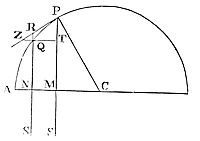
From C, the centre of the semi-circle, let the semi-diameter CA be drawn, cutting the parallels at right angles in M and N, and join CP. Because of the similar triangles CPM, PZT, and RZQ, we shall have CP² to PM² as PR² to QT²; and, from the nature of the circle, PR² is equal to the rectangle QR × RN+QN, or, the points P, Q coinciding, to the rectangle QR × 2PM. Therefore CP² is to PM² as QR × 2PM to QT²; and QT²/QR = 2PM³/CP², and (QT² × SP²)/QR = (2PM³ × SP²)/CP². And therefore (by Corol. 1 and 5, Prop. VI.), the centripetal force is reciprocally as (2PM³ × SP²)/CP²; that is (neglecting the given ratio2SP²/CP²), reciprocally as PM³. Q.E.I.
And the same thing is likewise easily inferred from the preceding Proposition.
SCHOLIUM.
And by a like reasoning, a body will be moved in an ellipsis, or even in an hyperbola, or parabola, by a centripetal force which is reciprocally as the cube of the ordinate directed to an infinitely remote centre of force.