To find the horary variation of the inclination of the moon's orbit to the plane of the ecliptic.
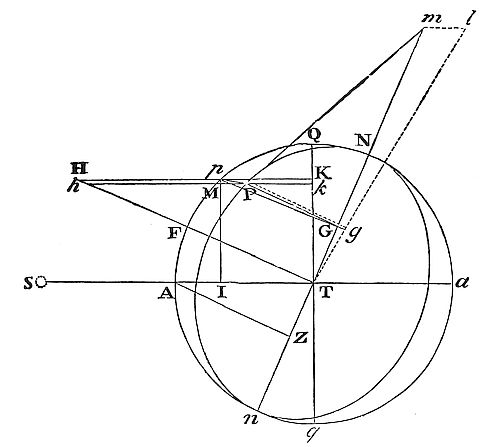
Let A and a represent the syzygies; Q, and q the quadratures; N and n the nodes; P the place of the moon in its orbit; p the orthographic projection of that place upon the plane of the ecliptic; and mTl the momentaneous motion of the nodes as above. If upon Tm we let fall the perpendicular PG, and joining pG we produce it till it meet Tl in g, and join also Pg, the angle PGp will be the inclination of the moon's orbit to the plane of the ecliptic when the moon is in P; and the angle Pgp will be the inclination of the same after a small moment of time is elapsed; and therefore the angle GPg will be the momentaneous variation of the inclination. But this angle GPg is to the angle GTg as TG to PG and Pp to PG conjunctly. And, therefore, if for the moment of time we assume an hour, since the angle GTg (by Prop. XXX) is to the angle 33'' 10''' 33iv. as IT × PG × AZ to AT3, the angle GPg (or the horary variation of the inclination) will be to the angle 33'' 10''' 33iv. as IT × AZ × TG × Pp/PG to AT3. Q.E.I.
And thus it would be if the moon was uniformly revolved in a circular orbit. But if the orbit is elliptical, the mean motion of the nodes will be diminished in proportion of the lesser axis to the greater, as we have shewn above; and the variation of the inclination will be also diminished in the same proportion.
COR. 1. Upon Nn erect the perpendicular TF, and let pM be the horary motion of the moon in the plane of the ecliptic; upon QT let fall the perpendiculars pK, Mk, and produce them till they meet TF in H and h; then IT will be to AT as Kk to Mp; and TG to Hp as TZ to AT; and, therefore, IT × TG will be equal to (Kk × Hp × TZ)/Mp, that is, equal to the area HpMh multiplied into the ratio TZ/Mp: and therefore the horary variation of the inclination will be to 33'' 10''' 33iv. as the area HpMh multiplied into AZ × TZ/Mp × Pp/PG to AT3.
COR. 2. And, therefore, if the earth and nodes were after every hour drawn back from their new and instantly restored to their old places, so as their situation might continue given for a whole periodic month together, the whole variation of the inclination during that month would be to 33'' 10''' 33iv. as the aggregate of all the areas HpMh, generated in the time of one revolution of the point p (with due regard in summing to their proper signs + -), multiplied into AZ × TZ × Pp/PG to Mp × AT3; that is, as the whole circle QAqa multiplied into AZ × TZ × Pp/PG to Mp × AT3, that is, as the circumference QAqa multiplied into AZ × TZ × Pp/PG to 2Mp × AT2.
COR. 3. And, therefore, in a given position of the nodes, the mean horary variation, from which, if uniformly continued through the whole month, that menstrual variation might be generated, is to 33'' 10''' 33iv. as AZ × TZ × Pp/PG to 2AT2, or as Pp × (AZ × TZ)/(^(1/2)AT) to PG × 4AT; that is (because Pp is to PG as the sine of the aforesaid inclination to the radius, and (AZ × TZ)/(^(1/2)AT) to 4AT as the sine of double the angle ATn to four times the radius), as the sine of the same inclination multiplied into the sine of double the distance of the nodes from the sun to four times the square of the radius.
COR. 4. Seeing the horary variation of the inclination, when the nodes are in the quadratures, is (by this Prop.) to the angle 33'' 10''' 33iv. as IT × AZ × TG × Pp/PG to AT3, that is, as (IT × TG)/(^(1/2)AT) × Pp/PG to 2AT, that is, as the sine of double the distance of the moon from the quadratures multiplied into Pp/PG to twice the radius, the sum of all the horary variations during the time that the moon, in this situation of the nodes, passes from the quadrature to the syzygy (that is, in the space of 177^(1/6) hours) will be to the sum of as many angles 33'' 10''' 33iv. or 5878'', as the sum of all the sines of double the distance of the moon from the quadratures multiplied into Pp/PG to the sum of as many diameters; that is, as the diameter multiplied into Pp/PG to the circumference; that is, if the inclination be 5° 1', as 7 × ^(874/10000) to 22, or as 278 to 10000. And, therefore, the whole variation, composed out of the sum of all the horary variations in the aforesaid time, is 163'', or 2' 43''.