Funependulous bodies that are, in any medium, resisted in the ratio of the moments of time, and funependulous bodies that move in a non-resisting medium of the same specific gravity, perform their oscillations in a cycloid in the same time, and describe proportional parts of arcs together.
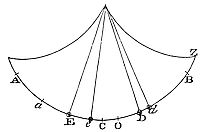
Let AB be an arc of a cycloid, which a body D, by vibrating in a non-resisting medium, shall describe in any time. Bisect that arc in C, so that C may be the lowest point thereof; and the accelerative force with which the body is urged in any place D, or d or E, will be as the length of the arc CD, or Cd, or CE. Let that force be expressed by that same arc; and since the resistance is as the moment of the time, and therefore given, let it be expressed by the given part CO of the cycloidal arc, and take the arc Od in the same ratio to the arc CD that the arc OB has to the arc CB: and the force with which the body in d is urged in a resisting medium, being the excess of the force Cd above the resistance CO, will be expressed by the arc Od, and will therefore be to the force with which the body D is urged in a non-resisting medium in the place D, as the arc Od to the arc CD; and therefore also in the place B, as the arc OB to the arc CB. Therefore if two bodies D, d go from the place B, and are urged by these forces; since the forces at the beginning are as the arc CB and OB, the first velocities and arcs first described will be in the same ratio. Let those arcs be BD and Bd, and the remaining arcs CD, Od, will be in the same ratio. Therefore the forces, being proportional to those arcs CD, Od, will remain in the same ratio as at the beginning, and therefore the bodies will continue describing together arcs in the same ratio. Therefore the forces and velocities and the remaining arcs CD, Od, will be always as the whole arcs CB, OB, and therefore those remaining arcs will be described together. Therefore the two bodies D and d will arrive together at the places C and O; that which moves in the non-resisting medium, at the place C, and the other, in the resisting medium, at the place O. Now since the velocities in C and O are as the arcs CB, OB, the arcs which the bodies describe when they go farther will be in the same ratio. Let those arcs be CE and Oe. The force with which the body D in a non-resisting medium is retarded in E is as CE, and the force with which the body d in the resisting medium is retarded in e, is as the sum of the force Ce and the resistance CO, that is, as Oe; and therefore the forces with which the bodies are retarded are as the arcs CB, OB, proportional to the arcs CE, Oe; and therefore the velocities, retarded in that given ratio, remain in the same given ratio.
Therefore the velocities and the arcs described with those velocities are always to each other in that given ratio of the arcs CB and OB; and therefore if the entire arcs AB, aB are taken in the same ratio, the bodies D and d will describe those arcs together, and in the places A and a will lose all their motion together. Therefore the whole oscillations are isochronal, or are performed in equal times; and any parts of the arcs, as BD, Bd, or BE, Be, that are described together, are proportional to the whole arcs BA, Ba. Q.E.D.
COR. Therefore the swiftest motion in a resisting medium does not fall upon the lowest point C, but is found in that point O, in which the whole arc described Ba, is bisected. And the body, proceeding from thence to a, is retarded at the same rate with which it was accelerated before in its descent from B to O.