Let the density of any fluid be proportional to the compression, and its parts be attracted downwards by a gravitation reciprocally proportional to the squares of the distances from the centre: I say, that if the distances be taken in harmonic progression, the densities of the fluid at those distances will be in a geometrical progression.
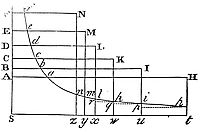
Let S denote the centre, and SA, SB, SC, SD, SE, the distances in geometrical progression. Erect the perpendiculars AH, BI, CK, &c., which shall be as the densities of the fluid in the places A, B, C, D, E, &c., and the specific gravities thereof in those places will be as AH/SA², BI/SB², CK/SC², &c. Suppose these gravities to be uniformly continued, the first from A to B, the second from B to C, the third from C to D, &c. And these drawn into the altitudes AB, BC, CD, DE, &c., or, which is the same thing, into the distances SA, SB, SC, &c., proportional to those altitudes, will give AH/SA, BI/SB, CK/SC, &c., the exponents of the pressures. Therefore since the densities are as the sums of those pressures, the differences AH - BI, BI - CK, &c., of the densities will be as the differences of those sums AH/SA, BI/SB, CK/SC &c. With the centre S, and the asymptotes SA, Sx, describe any hyperbola, cutting the perpendiculars AH, BI, CK, &c., in a, b, c, &c., and the perpendiculars Ht, Iu, Kw, let fall upon the asymptote Sx, in h, i, k; and the differences of the densities tu, uw, &c., will be as AH/SA, BI/SB, &c. And the rectangles tu × th, uw × ui, &c., or tp, uq, &c., as (AH × tℎ)/SA, (BI × ui)/SB, &c., that is, as Aa, Bb, &c. For, by the nature of the hyperbola, SA is to AH or St as th to Aa, and therefore (AH × tℎ)/SA is equal to Aa. And, by a like reasoning, (BI × ui)/SB is equal to Bb, &c. But Aa, Bb, Cc, &c., are continually proportional, and therefore proportional to their differences Aa - Bb, Bb - Cc, &c., therefore the rectangles tp, uq, &c., are proportional to those differences; as also the sums of the rectangles tp + uq, or tp + uq + wr to the sums of the differences Aa - Cc or Aa - Dd. Suppose several of these terms, and the sum of all the differences, as Aa - Ff, will be proportional to the sum of all the rectangles, as zthn. Increase the number of terms, and diminish the distances of the points A, B, C, &c., in infinitum, and those rectangles will become equal to the hyperbolic area zthn, and therefore the difference Aa - Ff is proportional to this area. Take now any distances, as SA, SD, SF, in harmonic progression, and the differences Aa - Dd, Dd - Ff will be equal; and therefore the areas thlx, xlnz, proportional to those differences will be equal among themselves, and the densities St, Sx, Sz, that is, AH, DL, FN, continually proportional. Q.E.D.
COR. Hence if any two densities of the fluid, as AH and BI, be given, the area thiu, answering to their difference tu, will be given; and thence the density FN will be found at any height SF, by taking the area thnz to that given area thiu as the difference Aa - Ff to the difference Aa - Bb.
SCHOLIUM.
By a like reasoning it may be proved, that if the gravity of the particles of a fluid be diminished in a triplicate ratio of the distances from the centre; and the reciprocals of the squares of the distances SA, SB, SC, &c., (namely,SA³/SA²,SA³/SB²,SA³/SC²) be taken in an arithmetical progression, the densities AH, BI, CK, &c., will be in a geometrical progression. And if the gravity be diminished in a quadruplicate ratio of the distances, and the reciprocals of the cubes of the distances (asSA⁴/SA³,SA⁴/SB³,SA⁴/SC³,&c.,) be taken in arithmetical progression, the densities AH, BI, CK, &c., will be in geometrical progression. And so in infinitum. Again; if the gravity of the particles of the fluid be the same at all distances, and the distances be in arithmetical progression, the densities will be in a geometrical progression as Dr. Halley has found. If the gravity be as the distance, and the squares of the distances be in arithmetical progression, the densities will be in geometrical progression. And so in infinitum. These things will be so, when the density of the fluid condensed by compression is as the force of compression; or, which is the same thing, when the space possessed by the fluid is reciprocally as this force. Other laws of condensation may be supposed, as that the cube of the compressing force may be as the biquadrate of the density; or the triplicate ratio of the force the same with the quadruplicate ratio of the density: in which case, if the gravity be reciprocally as the square of the distance from the centre, the density will be reciprocally as the cube of the distance. Suppose that the cube of the compressing force be as the quadrato-cube of the density; and if the gravity be reciprocally as the square of the distance, the density will be reciprocally in a sesquiplicate ratio of the distance. Suppose the compressing force to be in a duplicate ratio of the density, and the gravity reciprocally in a duplicate ratio of the distance, and the density will be reciprocally as the distance. To run over all the cases that might be offered would be tedious. But as to our own air, this is certain from experiment, that its density is either accurately, or very nearly at least, as the compressing force; and therefore the density of the air in the atmosphere of the earth is as the weight of the whole incumbent air, that is, as the height of the mercury in the barometer.