If the density of the medium in each of the places be reciprocally as the distance of the places from the immoveable centre, and the centripetal force be reciprocally as any power of the same distance, I say, that the body may revolve in a spiral intersecting all the radii drawn from that centre in a given angle.
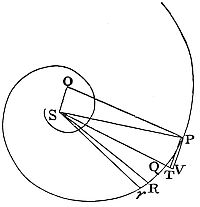
This is demonstrated in the same manner as the foregoing Proposition. For if the centripetal force in P be reciprocally as any power SPⁿ⁺¹ of the distance SP whose index is n + 1; it will be collected, as above, that the time in which the body describes any arc PQ, will be as PQ × PS^(^(1/2)n); and the resistance in P as Rr/(PQ² × SPⁿ), or as (1−^(1/2)n × VQ)/(PQ × SPⁿ × SQ), and therefore as (1−^(1/2)n × OS)/(OP × SPⁿ⁺¹), that is, ⎛⎝because(1−^(1/2)n × OS)/OP⎞⎠ is a given quantity), reciprocally as SPⁿ⁺¹. And therefore, since the velocity is reciprocally as SP^(^(1/2)n), the density in P will be reciprocally as SP.
COR. 1. The resistance is to the centripetal force as 1−^(1/2)n × OS to OP.
COR. 2. If the centripetal force be reciprocally as SP3, 1−^(1/2)n will be = 0; and therefore the resistance and density of the medium will be nothing, as in Prop. IX, Book I.
COR. 3. If the centripetal force be reciprocally as any power of the radius SP, whose index is greater than the number 3, the affirmative resistance will be changed into a negative.
SCHOLIUM.
This Proposition and the former, which relate to mediums of unequal density, are to be understood of the motion of bodies that are so small, that the greater density of the medium on one side of the body above that on the other is not to be considered. I suppose also the resistance, cæteris paribus, to be proportional to its density. Whence, in mediums whose force of resistance is not as the density, the density must be so much augmented or diminished, that either the excess of the resistance may be taken away, or the defect supplied.