The evanescent subtense of the angle of contact, in all curves which at the point of contact have a finite curvature, is ultimately in the duplicate ratio of the subtense of the conterminate arc.
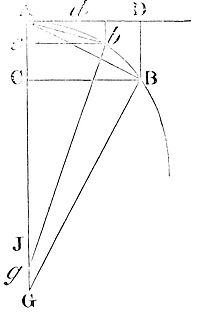
CASE 1. Let AB be that arc, AD its tangent, BD the subtense of the angle of contact perpendicular on the tangent, AB the subtense of the arc. Draw BG perpendicular to the subtense AB, and AG to the tangent AD, meeting in G; then let the points D, B, and G, approach to the points d, b, and g, and suppose J to be the ultimate intersection of the lines BG, AG, when the points D, B, have come to A. It is evident that the distance GJ may be less than any assignable. But (from the nature of the circles passing through the points A, B, G, A, b, g,) AB² = AG × BD, and Ab² = Ag × bd; and therefore the ratio of AB² to Ab² is compounded of the ratios of AG to Ag, and of Bd to bd. But because GJ may be assumed of less length than any assignable, the ratio of AG to Ag may be such as to differ from the ratio of equality by less than any assignable difference; and therefore the ratio of AB² to Ab² may be such as to differ from the ratio of BD to bd by less than any assignable difference. Therefore, by Lem. I, the ultimate ratio of AB² to Ab² is the same with the ultimate ratio of BD to bd. Q.E.D.
CASE 2. Now let BD be inclined to AD in any given angle, and the ultimate ratio of BD to bd will always be the same as before, and therefore the same with the ratio of AB² to Ab². Q.E.D.
CASE 3. And if we suppose the angle D not to be given, but that the right line BD converges to a given point, or is determined by any other condition whatever; nevertheless the angles D, d, being determined by the same law, will always draw nearer to equality, and approach nearer to each other than by any assigned difference, and therefore, by Lem. I, will at last be equal; and therefore the lines BD, bd are in the same ratio to each other as before. Q.E.D.
COR. 1. Therefore since the tangents AD, Ad, the arcs AB, Ab, and their sines, BC, bc, become ultimately equal to the chords AB, Ab, their squares will ultimately become as the subtenses BD, bd.
COR. 2. Their squares are also ultimately as the versed sines of the arcs, bisecting the chords, and converging to a given point. For those versed sines are as the subtenses BD, bd.
COR. 3. And therefore the versed sine is in the duplicate ratio of the time in which a body will describe the arc with a given velocity.
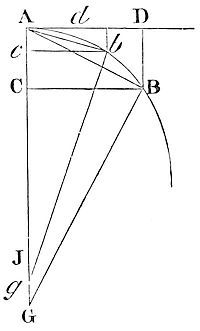
COR. 4. The rectilinear triangles ADB, Adb are ultimately in the triplicate ratio of the sides AD, Ad, and in a sesquiplicate ratio of the sides DB, db; as being in the ratio compounded of the sides AD to DB, and of Ad to db. So also the triangles ABC, Abc are ultimately in the triplicate ratio of the sides BC, bc. What I call the sesquiplicate ratio is the subduplicate of the triplicate, as being compounded of the simple and subduplicate ratio.
COR. 5. And because DB, db are ultimately parallel and in the duplicate ratio of the lines AD, Ad, the ultimate curvilinear areas ADB, Adb will be (by the nature of the parabola) two thirds of the rectilinear triangles ADB, Adb and the segments AB, Ab will be one third of the same triangles. And thence those areas and those segments will be in the triplicate ratio as well of the tangents AD, Ad, as of the chords and arcs AB, AB.
SCHOLIUM.
But we have all along supposed the angle of contact to be neither infinitely greater nor infinitely less than the angles of contact made by circles and their tangents; that is, that the curvature at the point A is neither infinitely small nor infinitely great, or that the interval AJ is of a finite magnitude. For DB may be taken as AD3: in which case no circle can be drawn through the point A, between the tangent AD and the curve AB, and therefore the angle of contact will be infinitely less than those of circles. And by a like reasoning, if DB be made successfully as AD⁴, AD⁵, AD⁶, AD⁷, &c., we shall have a series of angles of contact, proceeding in infinitum, wherein every succeeding term is infinitely less than the preceding. And if DB be made successively as AD², AD^(3/2), AD^(4/3), AD^(5/4), AD^(6/5), AD^(7/6), &c., we shall have another infinite series of angles of contact, the first of which is of the same sort with those of circles, the second infinitely greater, and every succeeding one infinitely greater than the preceding. But between any two of these angles another series of intermediate angles of contact may be interposed, proceeding both ways in infinitum, wherein every succeeding angle shall be infinitely greater or infinitely less than the preceding. As if between the terms AD² and AD³ there were interposed the series AD^(13/6), AD^(11/5), AD^(9/4), AD^(7/3), AD^(5/2), AD^(8/3), AD^(11/4), AD^(14/5), AD^(17/6), &c. And again, between any two angles of this series, a new series of intermediate angles may be interposed, differing from one another by infinite intervals. Nor is nature confined to any bounds.
Those things which have been demonstrated of curve lines, and the superfices which they comprehend, may be easily applied to the curve superfices and contents of solids. These Lemmas are premised to avoid the tediousness of deducing perplexed demonstrations ad absurdum, according to the method of the ancient geometers. For demonstrations are more contracted by the method of indivisibles: but because the hypothesis of indivisibles seems somewhat harsh, and therefore that method is reckoned less geometrical, I chose rather to reduce the demonstrations of the following propositions to the first and last sums and ratios of nascent and evanescent quantities, that is, to the limits of those sums and ratios; and so to premise, as short as I could, the demonstrations of those limits. For hereby the same thing is performed as by the method of indivisibles; and now those principles being demonstrated, we may use them with more safety. Therefore if hereafter I should happen to consider quantities as made up of particles, or should use little curve lines for right ones, I would not be understood to mean indivisibles, but evanescent divisible quantities; not the sums and ratios of determinate parts, but always the limits of sums and ratios; and that the force of such demonstrations always depends on the method laid down in the foregoing Lemmas.
Perhaps it may be objected, that there is no ultimate proportion, of evanescent quantities; because the proportion, before the quantities have vanished, is not the ultimate, and when they are vanished, is none. But by the same argument, it may be alledged, that a body arriving at a certain place, and there stopping, has no ultimate velocity: because the velocity, before the body comes to the place, is not its ultimate velocity; when it has arrived, is none. But the answer is easy; for by the ultimate velocity, is meant that with which the body is moved, neither before it arrives at its last place and the motion ceases, nor after, but at the very instant it arrives; that is, that velocity with which the body arrives at its last place, and with which the motion ceases. And in like manner, by the ultimate ratio of evanescent quantities is to be understood the ratio of the quantities not before they vanish, nor afterwards, but with which they vanish. In like manner the first ratio of nascent quantities is that with which they begin to be. And the first or last sum is that with which they begin and cease to be (or to be augmented or diminished). There is a limit which the velocity at the end of the motion may attain, but not exceed. This is the ultimate velocity. And there is the like limit in all quantities and proportions that begin and cease to be. And since such limits are certain and definite, to determine the same is a problem strictly geometrical. But whatever is geometrical we may be allowed to use in determining and demonstrating any other thing that is likewise geometrical.
It may also be objected, that if the ultimate ratios of evanescent quantities are given, their ultimate magnitudes will be also given: and so all quantities will consist of indivisibles, which is contrary to what Euclid has demonstrated concerning incommensurables, in the 10th Book of his Elements. But this objection is founded on a false supposition. For those ultimate ratios with which quantities vanish are not truly the ratios of ultimate quantities, but limits towards which the ratios of quantities decreasing without limit do always converge; and to which they approach nearer than by any given difference, but never go beyond, nor in effect attain to, till the quantities are diminished in infinitum. This thing will appear more evident in quantities infinitely great. If two quantities, whose difference is given, be augmented in infinitum, the ultimate ratio of these quantities will be given, to wit, the ratio of equality; but it does not from thence follow, that the ultimate or greatest quantities themselves, whose ratio that is, will be given. Therefore if in what follows, for the sake of being more easily understood, I should happen to mention quantities as least, or evanescent, or ultimate, you are not to suppose that quantities of any determinate magnitude are meant, but such as are conceived to be always diminished without end.