The same things being supposed, I say, that the space described in the ascent or descent is as the difference of the area by which the time is expressed, and of some other area which is augmented or diminished in an arithmetical progression; if the forces compounded of the resistance and the gravity be taken in a geometrical progression.
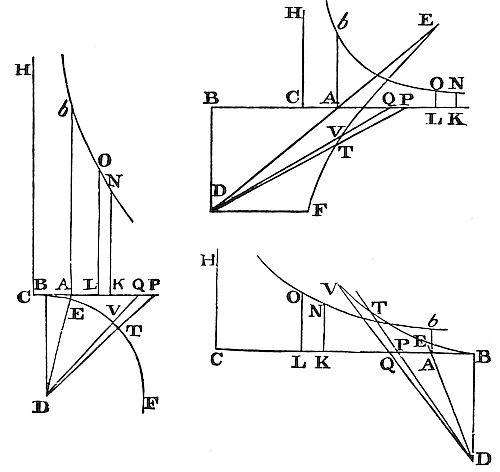
Take AC (in these three figures) proportional to the gravity, and AK to the resistance; but take them on the same side of the point A, if the body is descending, otherwise on the contrary. Erect Ab, which make to DB as DB2 to 4BAC: and to the rectangular asymptotes CK, CH, describe the hyperbola bN; and, erecting KN perpendicular to CK, the area AbNK will be augmented or diminished in an arithmetical progression, while the forces CK are taken in a geometrical progression. I say, therefore, that the distance of the body from its greatest altitude is as the excess of the area AbNK above the area DET.
For since AK is as the resistance, that is, as AP2 × 2BAP; assume any given quantity Z, and put AK equal to (AP²+2BAP)/Z; then (by Lem. II of this Book) the moment KL of AK will be equal to (2APQ+2BA × PQ)/Z or 2BPQ/Z, and the moment KLON of the area AbNK will be equal to (2BPQ × LO)/Z or (BPQ × BD²)/(2Z × CK × AB).
CASE 1. Now if the body ascends, and the gravity be as AB2 + BD2 BET being a circle, the line AC, which is proportional to the gravity, will be (AB²+BD²)/Z, and DP2 or AP2 + 2BAP + AB2 + BD2 will be AK × Z + AC × Z or CK × Z; and therefore the area DTV will be to the area DPQ as DT2 or DB2 to CK × Z.
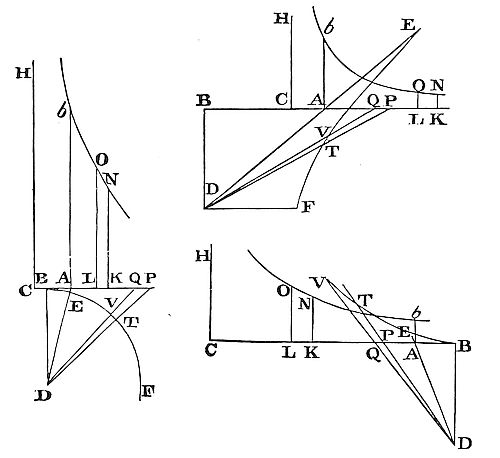
CASE 2. If the body ascends, and the gravity be as AB2 - BD2, the line AC will be (AB²−BD²)/Z, and DT2 will be to DP2 as DF2 or DB2 to BP2 - BD2 or AP2 + 2BAP + AB2 - BD2, that is, to AK × Z + AC × Z or CK × Z. And therefore the area DTV will be to the area DPQ as DB2 to CK × Z.
CASE 3. And by the same reasoning, if the body descends, and therefore the gravity is as BD2 - AB2, and the line AC becomes equal to (BD²−AB²)/Z; the area DTV will be to the area DPQ as DB2 to CK × Z: as above.
Since, therefore, these areas are always in this ratio, if for the area DTV, by which the moment of the time, always equal to itself, is expressed, there be put any determinate rectangle, as BD × m, the area DPQ, that is, ^(1/2)BD × PQ, will be to BD × m as CK × Z to BD2. And thence PQ × BD3 becomes equal to 2BD × m × CK × Z, and the moment KLON of the area AbNK, found before, becomes (BP × BD × m)/AB. From the area DET subduct its moment DTV or BD × m, and there will remain (AP × BD × m)/AB. Therefore the difference of the moments, that is, the moment of the difference of the areas, is equal to (AP × BD × m)/AB; and therefore (because of the given quantity(BD × m)/AB) as the velocity AP; that is, as the moment of the space which the body describes in its ascent or descent. And therefore the difference of the areas, and that space, increasing or decreasing by proportional moments, and beginning together or vanishing together, are proportional. Q.E.D.
COR. If the length, which arises by applying the area DET to the line BD, be called M; and another length V be taken in that ratio to the length M, which the line DA has to the line DE; the space which a body, in a resisting medium, describes in its whole ascent or descent, will be to the space which a body, in a non-resisting medium, falling from rest, can describe in the same time, as the difference of the aforesaid areas to (BD × V²)/AB; and therefore is given from the time given. For the space in a non-resisting medium is in a duplicate ratio of the time, or as V2; and, because BD and AB are given, as (BD × V²)/AB. This area is equal to the area (DA² × BD × M²)/(DE² × AB) and the moment of M is m; and therefore the moment of this area is (DA² × BD × 2M × m)/(DE² × AB). But this moment is to the moment of the difference of the aforesaid areas DET and AbNK, viz., to (AP × BD × × m)/AB, as (DA² × BD × M)/DE² to ^(1/2)BD × AP, or as DA²/DE² into DET to DAP; and, therefore, when the areas DET and DAP are least, in the ratio of equality. Therefore the area (BD × V²)/AB and the difference of the areas DET and AbNK, when all these areas are least, have equal moments; and are therefore equal. Therefore since the velocities, and therefore also the spaces in both mediums described together, in the beginning of the descent, or the end of the ascent, approach to equality, and therefore are then one to another as the area (BD × V²)/AB, and the difference of the areas DET and AbNK; and moreover since the space, in a non-resisting medium, is perpetually as (BD × V²)/AB, and the space, in a resisting medium, is perpetually as the difference of the areas DET and AbNK; it necessarily follows, that the spaces, in both mediums, described in any equal times, are one to another as that area (BD × V²)/AB, and the difference of the areas DET and AbNK. Q.E.D.
SCHOLIUM.
The resistance of spherical bodies in fluids arises partly from the tenacity, partly from the attrition, and partly from the density of the medium. And that part of the resistance which arises from the density of the fluid is, as I said, in a duplicate ratio of the velocity; the other part, which arises from the tenacity of the fluid, is uniform, or as the moment of the time; and, therefore, we might now proceed to the motion of bodies, which are resisted partly by an uniform force, or in the ratio of the moments of the time, and partly in the duplicate ratio of the velocity. But it is sufficient to have cleared the way to this speculation in Prop. VIII and IX foregoing, and their Corollaries. For in those Propositions, instead of the uniform resistance made to an ascending body arising from its gravity, one may substitute the uniform resistance which arises from the tenacity of the medium, when the body moves by its vis insita alone; and when the body ascends in a right line, add this uniform resistance to the force of gravity, and subduct it when the body descends in a right line. One might also go on to the motion of bodies which are resisted in part uniformly, in part in the ratio of the velocity, and in part in the duplicate ratio of the same velocity. And I have opened a way to this in Prop. XIII and XIV foregoing, in which the uniform resistance arising from the tenacity of the medium may be substituted for the force of gravity, or be compounded with it as before. But I hasten to other things.