If a body be resisted partly in the ratio and partly in the duplicate ratio of its velocity, and moves in a similar medium by its innate force only; and the times be taken in arithmetical progression; then quantities reciprocally proportional to the velocities, increased by a certain given quantity, will be in geometrical progression.
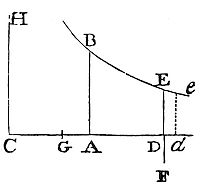
With the centre C, and the rectangular asymptotes CADd and CH, describe an hyperbola BEe, and let AB, DE, de, be parallel to the asymptote CH. In the asymptote CD let A, G be given points; and if the time be expounded by the hyperbolic area ABED uniformly increasing, I say, that the velocity may be expressed by the length DF, whose reciprocal GD, together with the given line CG, compose the length CD increasing in a geometrical progression.
For let the areola DEed be the least given increment of the time, and Dd will be reciprocally as DE, and therefore directly as CD. Therefore the decrement of 1/GD, which (by Lem. II, Book II) is Dd/GD², will be also as CD/GD² or (CG+GD)/GD², that is, as 1/GD+CG/GD². Therefore the time ABED uniformly increasing by the addition of the given particles EDde, it follows that 1/GD decreases in the same ratio with the velocity. For the decrement of the velocity is as the resistance, that is (by the supposition), as the sum of two quantities, whereof one is as the velocity, and the other as the square of the velocity; and the decrement of 1/GD is as the sum of the quantities 1/GD and CG/GD², whereof the first is 1/GD itself, and the last CG/GD² is as 1/GD²: therefore 1/GD is as the velocity, the decrements of both being analogous. And if the quantity GD reciprocally proportional to 1/GD, be augmented by the given quantity CG; the sum CD, the time ABED uniformly increasing, will increase in a geometrical progression. Q.E.D.
COR. 1. Therefore, if, having the points A and G given, the time be expounded by the hyperbolic area ABED, the velocity may be expounded by 1/GD the reciprocal of GD.
COR. 2. And by taking GA to GD as the reciprocal of the velocity at the beginning to the reciprocal of the velocity at the end of any time ABED, the point G will be found. And that point being found the velocity may be found from any other time given.