Suppose the uniform force of gravity to tend directly to the plane of the horizon, and the resistance to be as the density of the medium and the square of the velocity conjunctly: it is proposed to find the density of the medium in each place, which shall make the body move in any given curve line; the velocity of the body and the resistance of the medium in each place.
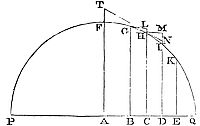
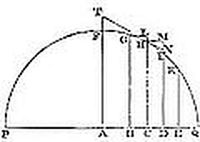
Let PQ be a plane perpendicular to the plane of the scheme itself; PFHQ a curve line meeting that plane in the points P and Q; G, H, I, K four places of the body going on in this curve from F to Q; and GB, HC, ID, KE four parallel ordinates let fall from these points to the horizon, and standing on the horizontal line PQ at the points B, C, D, E; and let the distances BC, CD, DE, of the ordinates be equal among themselves. From the points G and H let the right lines GL, HN, be drawn touching the curve in G and H, and meeting the ordinates CH, DI, produced upwards, in L and N: and complete the parallelogram HCDM. And the times in which the body describes the arcs GH, HI, will be in a subduplicate ratio of the altitudes LH, NI, which the bodies would describe in those times, by falling from the tangents; and the velocities will be as the lengths described GH, HI directly, and the times inversely. Let the times be expounded by T and t, and the velocities by GH/T and HI/t; the decrement of the velocity produced in the time t will be expounded by GH/T−HI/t. This decrement arises from the resistance which retards the body, and from the gravity which accelerates it. Gravity, in a falling body, which in its fall describes the space NI, produces a velocity with which it would be able to describe twice that space in the same time, as Galileo has demonstrated; that is, the velocity 2NI/t: but if the body describes the arc HI, it augments that arc only by the length HI−HN or (MI × NI)/HI; and therefore generates only the velocity (2MI × NI)/(t × HI). Let this velocity be added to the before-mentioned decrement, and we shall have the decrement of the velocity arising from the resistance alone, that is, GH/T−HI/t+(2MI × NI)/(t × HI). Therefore since, in the same time, the action of gravity generates, in a falling body, the velocity 2NI/t, the resistance will be to the gravity as GH/T−HI/t+(2MI × NI)/(t × HI) to 2NI/t or as (t × GH)/T−HI+(2MI × NI)/HI to 2NI.
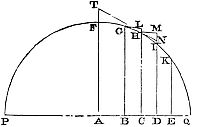
Now for the abscissas CB, CD, CE, put -o, o, 2o. For the ordinate CH put P; and for MI put any series Qo + Ro2 + So3 +, &c. And all the terms of the series after the first, that is, Ro2 + So3 +, &c., will be NI; and the ordinates DI, EK, and BG will be P - Qo - Ro2 - So3 -, &c., P - 2Qo - 4Ro2 - 8So3 -, &c., and P + Qo - Ro2 + So3 -, &c., respectively. And by squaring the differences of the ordinates BG - CH and CH - DI, and to the squares thence produced adding the squares of BC and CD themselves, you will have oo + QQoo - 2QRo3 +, &c., and oo + QQoo + 2QRo3 +, &c., the squares of the arcs GH, HI; whose roots o1/(√1+QQ)−QR_(oo)/(√1+QQ), and o√1+QQ+QR_(oo)/(√1+QQ) are the arcs GH and HI. Moreover, if from the ordinate CH there be subducted half the sum of the ordinates BG and DI, and from the ordinate DI there be subducted half the sum of the ordinates CH and EK, there will remain Roo and Roo + 3So3, the versed sines of the arcs GI and HK. And these are proportional to the lineolæ LH and NI, and therefore in the duplicate ratio of the infinitely small times T and t: and thence the ratio t/T is (√R+3S_(o))/R or (R+^(3/2)S_(o))/R; and (t × GH)/T−HI+(2MI × NI)/(t × HI), by substituting the values of t/T, GH, HI, MI and NI just found, becomes 3S_(oo)/2R√1+QQ. And since 2NI is 2Roo, the resistance will be now to the gravity as 3S_(oo)/2R√1+QQ to 2Roo, that is, as 3S√1+QQ to 4RR.
And the velocity will be such, that a body going off therewith from any place H, in the direction of the tangent HN, would describe, in vacuo, a parabola, whose diameter is HC, and its latus rectum HN²/NI or (1+QQ)/R.
And the resistance is as the density of the medium and the square of the velocity conjunctly; and therefore the density of the medium is as the resistance directly, and the square of the velocity inversely; that is, as (3S√1+QQ)/4RR directly and (1+QQ)/R inversely; that is, as S/(R√1+QQ) Q.E.I.
COR. 1. If the tangent HN be produced both ways, so as to meet any ordinate AF in THT/AC will be equal to √1+QQ, and therefore in what has gone before may be put for √1+QQ. By this means the resistance will be to the gravity as 3S × HT to 4RR × AC; the velocity will be as HT/AC√R, and the density of the medium will be as (S × AC)/(R × HT).
COR. 2. And hence, if the curve line PFHQ be defined by the relation between the base or abscissa AC and the ordinate CH, as is usual, and the value of the ordinate be resolved into a converging series, the Problem will be expeditiously solved by the first terms of the series; as in the following examples.
EXAMPLE 1. Let the line PFHQ be a semi-circle described upon the diameter PQ, to find the density of the medium that shall make a projectile move in that line.
Bisect the diameter PQ in A; and call AQ, n; AC, a; CH, e; and CD, o; then DI2 or AQ2 - AD2 = nn - aa - 2ao - oo, or ee - 2ao - oo; and the root being extracted by our method, will give DI = e−ao/e−oo/2e−aaoo/2e³−ao²/2e³−a³o³/2e⁵−, &c. Here put nn for ee + aa, and DI will become = e−ao/e−nnoo/2e³−anno³/2e⁵−, &c.
Such series I distinguish into successive terms after this manner: I call that the first term in which the infinitely small quantity o is not found; the second, in which that quantity is of one dimension only; the third, in which it arises to two dimensions; the fourth, in which it is of three; and so ad infinitum. And the first term, which here is e, will always denote the length of the ordinate CH, standing at the beginning of the indefinite quantity o. The second term, which here is ao/e, will denote the difference between CH and DN; that is, the lineola MN which is cut off by completing the parallelogram HCDM; and therefore always determines the position of the tangent HN; as, in this case, by taking MN to HM as ao/e to o, or a to e. The third term, which here is nnoo/2e³, will represent the lineola IN, which lies between the tangent and the curve; and therefore determines the angle of contact IHN, or the curvature which the curve line has in H. If that lineola IN is of a finite magnitude, it will be expressed by the third term, together with those that follow in infinitum. But if that lineola be diminished in infinitum, the terms following become infinitely less than the third term, and therefore may be neglected. The fourth term determines the variation of the curvature; the fifth, the variation of the variation; and so on. Whence, by the way, appears no contemptible use of these series in the solution of problems that depend upon tangents, and the curvature of curves.
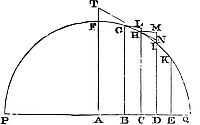
Now compare the series = e−ao/e−nnoo/2e³−anno³/2e⁵− &c., with the series P - Qo - Roo - So3 - &c., and for P, Q, R and S, put e, a/e, nn/2e³ and ann/2e⁵, and for √1+QQ put √1+^(aa/ee) or n/e; and the density of the medium will come out as a/ne; that is (because n is given), as a/e or AC/CH, that is, as that length of the tangent HT, which is terminated at the semi-diameter AF standing perpendicularly on PQ: and the resistance will be to the gravity as 3a to 2n, that is, as 3AC to the diameter PQ of the circle; and the velocity will be as √CH. Therefore if the body goes from the place F, with a due velocity, in the direction of a line parallel to PQ, and the density of the medium in each of the places H is as the length of the tangent HT, and the resistance also in any place H is to the force of gravity as 3AC to PQ, that body will describe the quadrant FHQ of a circle. Q.E.I.
But if the same body should go from the place P, in the direction of a line perpendicular to PQ, and should begin to move in an arc of the semi-circle PFQ, we must take AC or a on the contrary side of the centre A; and therefore its sign must be changed, and we must put -a for +a. Then the density of the medium would come out as −a/e. But nature does not admit of a negative density, that is, a density which accelerates the motion of bodies; and therefore it cannot naturally come to pass that a body by ascending from P should describe the quadrant PF of a circle. To produce such an effect, a body ought to be accelerated by an impelling medium, and not impeded by a resisting one.
EXAMPLE 2. Let the line PFQ be a parabola, having its axis AF perpendicular to the horizon PQ, to find the density of the medium, which will make a projectile move in that line.
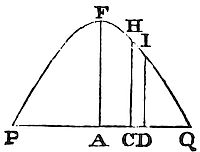
From the nature of the parabola, the rectangle PDQ is equal to the rectangle under the ordinate DI and some given right line; that is, if that right line be called b; PC, a; PQ, c; CH, e; and CD, o; the rectangle a + o into c - a - o or ac - aa - 2ao + co - oo, is equal to the rectangle b into DI, and therefore DI is equal to (ac−aa)/b+(c−2a)/bo−oo/b. Now the second term (c−2a)/bo of this series is to be put for Qo, and the third term oo/b for Roo. But since there are no more terms, the co-efficient S of the fourth term will vanish; and therefore the quantity S/(R√1+QQ), to which the density of the medium is proportional, will be nothing. Therefore, where the medium is of no density, the projectile will move in a parabola; as Galileo hath heretofore demonstrated. Q.E.I.
EXAMPLE 3. Let the line AGK be an hyperbola, having its asymptote NX perpendicular to the horizontal plane AK, to find the density of the medium that will make a projectile move in that line.
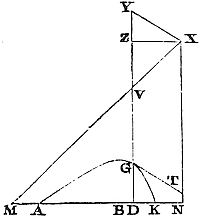
Let MX be the other asymptote, meeting the ordinate DG produced in V; and from the nature of the hyperbola, the rectangle of XV into VG will be given. There is also given the ratio of DN to VX, and therefore the rectangle of DN into VG is given. Let that be bb: and, completing the parallelogram DNXZ, let BN be called a; BD, o; NX, c; and let the given ratio of VZ to ZX or DN be m/n. Then DN will be equal to a - o, VG equal to bb/(a−o), VZ equal to m/n × a−o, and GD or NX - VZ - VG equal to c−m/na+m/no−bb/(a−o). Let the term bb/(a−o) be resolved into the converging series bb/a+bb/aao+bb/a³oo+bb/a⁴o³, &c., and GD will become equal to c−m/na−bb/a+m/no−bb/aao−bb/a³o²−bb/a⁴o³ &c. The second term m/no−bb/aao
of this series is to be used for Qo; the third bb/a³o², with its sign changed for Ro2; and the fourth bb/a⁴o³, with its sign changed also for So3, and their coefficients m/n−bb/aa, bb/a³ and bb/a⁴ are to be put for Q, R, and S in the former rule. Which being done, the density of the medium will come out as (^(bb/a⁴))/(^(bb/a³)√1+^(mm/nn)−^(2mbb/naa)+^(b⁴/a⁴)), or 1/(√aa+^(mm/nn)aa−^(2mbb/n)+^(b⁴/aa)), that is, if in VZ you take VY equal to VG, as 1/XY. For aa and m²/n²a²−2mbb/a+b⁴/a⁴ are the squares of XZand ZY. But the ratio of the resistance to gravity is found to be that of 3XY to 2YG; and the velocity is that with which the body would describe a parabola, whose vertex is G, diameter DG, latus rectum XY²/VG. Suppose, therefore, that the densities of the medium in each of the places G are reciprocally as the distances XY, and that the resistance in any place G is to the gravity as 3XY to 2YG; and a body let go from the place A, with a due velocity, will describe that hyperbola AGK. Q.E.I.
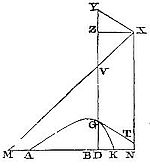
EXAMPLE 4. Suppose, indefinitely, the line AGK to be an hyperbola described with the centre X, and the asymptotes MX, NX, so that, having constructed the rectangle XZDN, whose side ZD cuts the hyperbola in G and its asymptote in V, VG may be reciprocally as any power DNn of the line ZX or DN, whose index is the number n: to find the density of the medium in which a projected body will describe this curve.
For BN, BD, NX, put A, O, C, respectively, and let VZ be to XZ or DN as d to e, and VG be equal to bb/DNⁿ; then DN will be equal to A - O, VG = bb/(A−O|ⁿ), VZ = ^(d/e)A−O, and GD or NX - VZ - VG equal to C−^(d/e)A+^(d/e)O−bb/(A−O|ⁿ). Let the term bb/(A−O|ⁿ) be resolved into an infinite series bb/Aⁿ+nbb/Aⁿ⁺¹ × O+(nn+n)/2Aⁿ⁺² × bbO²+(n³+3nn+2n)/6Aⁿ⁺³ × bbO³, &c., and GD will be equal to C−d/eA−bb/Aⁿ+d/eO−nbb/Aⁿ⁺¹O−(nn+n)/2Aⁿ⁺²bbO²−(n³+3nn+2n)/6Aⁿ⁺³bbO³, &c. The second term d/eO−nbb/Aⁿ⁺¹O of this series is to be used for Qo, the third (nn+n)/2Aⁿ⁺²bbO² for Roo, the fourth (n³+3nn+2n)/6Aⁿ⁺³bbO³ for So³. And thence the density of the medium S/(R√1+QQ), in any place G, will be (n+2)/(3√A²+^(dd/ee)A²−^(2dnbb/eAⁿ)A+^(nnb⁴/A²ⁿ)) and therefore if in VZ you take VY equal to n × VG, that density is reciprocally as XY. For A2 and dd/eeA²−2dnbb/eAⁿA+nnb⁴/A²ⁿ are the squares of XZ and ZY. But the resistance in the same place G is to the force of gravity as 3S × XY/A to 4RR, that is, as XY to (2nn+2n)/(n+2)VG. And the velocity there is the same wherewith the projected body would move in a parabola, whose vertex is G, diameter GD, and latus rectum (1+QQ)/R or 2XY²/(nn+n × VG). Q.E.I.
SCHOLIUM.
In the same manner that the density of the medium comes out to be as (S × AC)/(R × HT), in Cor. 1, if the resistance is put as any power Vn of the velocity V, the density of the medium will come out to be as S/(R^(^(4−n/2))) × AC/HTⁿ⁻¹. And therefore if a curve can be found, such that the ratio of S/(R^(^(4−n/2))) to HT/ACⁿ⁻¹ or of S³/R⁴⁻ⁿ to 1+QQ|ⁿ⁻¹ may be given; the body, in an uniform medium, whose resistance is as the power Vn of the velocity V, will move in this curve. But let us return to more simple curves.
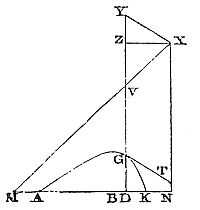
Because there can be no motion in a parabola except in a non-resisting medium, but in the hyperbolas here described it is produced by a perpetual resistance; it is evident that the line which a projectile describes in an uniformly resisting medium approaches nearer to these hyperbolas than to a parabola. That line is certainly of the hyperbolic kind, but about the vertex it is more distant from the asymptotes, and in the parts remote from the vertex draws nearer to them than these hyperbolas here described. The difference, however, is not so great between the one and the other but that these latter may be commodiously enough used in practice instead of the former. And perhaps these may prove more useful than an hyperbola that is more accurate, and at the same time more compounded. They may be made use of, then, in this manner.
Complete the parallelogram XYGT, and the right line GT will touch the hyperbola in G, and therefore the density of the medium in G is reciprocally as the tangent GT, and the velocity there as √^(GT²/GV); and the resistance is to the force of gravity as GT to (2nn+2n)/(n+2) × GV.
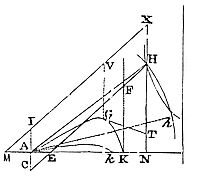
Therefore if a body projected from the place A, in the direction of the right line AH, describes the hyperbola AGK and AH produced meets the asymptote NX in H, and AI drawn parallel to it meets the other asymptote MX in I; the density of the medium in A will be reciprocally as AH, and the velocity of the body as √^(AH²/AI), and the resistance there to the force of gravity as AH to (2nn+2n)/(n+2) × AI. Hence the following rules are deduced.
RULE 1. If the density of the medium at A, and the velocity with which the body is projected remain the same, and the angle NAH be changed, the lengths AH, AI, HX will remain. Therefore if those lengths, in any one case, are found, the hyperbola may afterwards be easily determined from any given angle NAH.
RULE 2. If the angle NAH, and the density of the medium at A, remain the same, and the velocity with which the body is projected be changed, the length AH will continue the same; and AI will be changed in a duplicate ratio of the velocity reciprocally.
RULE 3. If the angle NAH, the velocity of the body at A, and the accelerative gravity remain the same, and the proportion of the resistance at A to the motive gravity be augmented in any ratio; the proportion of AH to AI will be augmented in the same ratio, the latus rectum of the above-mentioned parabola remaining the same, and also the length AH²/AI proportional to it; and therefore AH will be diminished in the same ratio, and AI will be diminished in the duplicate of that ratio. But the proportion of the resistance to the weight is augmented, when either the specific gravity is made less, the magnitude remaining equal, or when the density of the medium is made greater, or when, by diminishing the magnitude, the resistance becomes diminished in a less ratio than the weight.
RULE 4. Because the density of the medium is greater near the vertex of the hyperbola than it is in the place A, that a mean density may be preserved, the ratio of the least of the tangents GT to the tangent AH ought to be found, and the density in A augmented in a ratio a little greater than that of half the sum of those tangents to the least of the tangents GT.
RULE 5. If the lengths AH, AI are given, and the figure AGK is to be described, produce HN to X, so that HX may be to AI as n + 1 to 1; and with the centre X, and the asymptotes MX, NX, describe an hyperbola through the point A, such that AI may be to any of the lines VG as XVn to XIn.
RULE 6. By how much the greater the number n is, so much the more accurate are these hyperbolas in the ascent of the body from A, and less accurate in its descent to K; and the contrary. The conic hyperbola keeps a mean ratio between these, and is more simple than the rest. Therefore if the hyperbola be of this kind, and you are to find the point K, where the projected body falls upon any right line AN passing through the point A, let AN produced meet the asymptotes MX, NX in M and N, and take NK equal to AM.
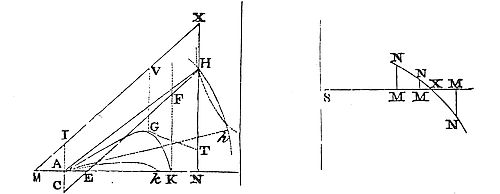
RULE 7. And hence appears an expeditious method of determining this hyperbola from the phenomena. Let two similar and equal bodies be projected with the same velocity, in different angles HAK, hAk, and let them fall upon the plane of the horizon in K and k; and note the proportion of AK to Ak. Let it be as d to e. Then erecting a perpendicular AI of any length, assume any how the length AH or Ah, and thence graphically, or by scale and compass, collect the lengths AK, Ak (by Rule 6). If the ratio of AK to Ak be the same with that of d to e, the length of AH was rightly assumed. If not, take on the indefinite right line SM, the length SM equal to the assumed AH; and erect a perpendicular MN equal to the difference AK/Ak−d/e of the ratios drawn into any given right line. By the like method, from several assumed lengths AH, you may find several points N; and draw through them all a regular curve NNXN, cutting the right line SMMM in X. Lastly, assume AH equal to the abscissa SX, and thence find again the length AK; and the lengths, which are to the assumed length AI, and this last AH, as the length AK known by experiment, to the length AK last found, will be the true lengths AI and AH, which were to be found. But these being given, there will be given also the resisting force of the medium in the place A, it being to the force of gravity as AH to 4/3AI. Let the density of the medium be increased by Rule 4, and if the resisting force just found be increased in the same ratio, it will become still more accurate.
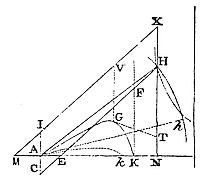
RULE 8. The lengths AH, HX being found; let there be now required the position of the line AH, according to which a projectile thrown with that given velocity shall fall upon any point K. At the points A and K, erect the lines AC, KF perpendicular to the horizon; whereof let AC be drawn downwards, and be equal to AI or ^(1/2)HX. With the asymptotes AK, KF, describe an hyperbola, whose conjugate shall pass through the point C; and from the centre A, with the interval AH, describe a circle cutting that hyperbola in the point H; then the projectile thrown in the direction of the right line AH will fall upon the point K. Q.E.I. For the point H, because of the given length AH, must be somewhere in the circumference of the described circle. Draw CH meeting AK and KF in E and F; and because CH, MX are parallel, and AC, AI equal, AE will be equal to AM, and therefore also equal to KN. But CE is to AE as FH to KN, and therefore CE and FH are equal. Therefore the point H falls upon the hyperbolic curve described with the asymptotes AK, KF whose conjugate passes through the point C; and is therefore found in the common intersection of this hyperbolic curve and the circumference of the described circle. Q.E.D. It is to be observed that this operation is the same, whether the right line AKN be parallel to the horizon, or inclined thereto in any angle; and that from two intersections H, h, there arise two angles NAH, NAh; and that in mechanical practice it is sufficient once to describe a circle, then to apply a ruler CH, of an indeterminate length, so to the point C, that its part FH, intercepted between the circle and the right line FK, may be equal to its part CE placed between the point C and the right line AK.
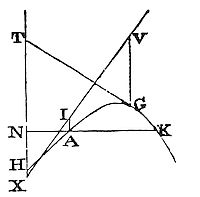
What has been said of hyperbolas may be easily applied to parabolas. For if a parabola be represented by XAGK, touched by a right line XV in the vertex X, and the ordinates IA, VG be as any powers XIn, XVn, of the abscissas XI, XV; draw XT, GT, AH, whereof let XT be parallel to VG, and let GT, AH touch the parabola in G and A: and a body projected from any place A, in the direction of the right line AH, with a due velocity, will describe this parabola, if the density of the medium in each of the places G be reciprocally as the tangent GT. In that case the velocity in G will be the same as would cause a body, moving in a non-resisting space, to describe a conic parabola, having G for its vertex, VG produced downwards for its diameter, and 2GT²/(nn−n × GV) for its latus rectum. And the resisting force in G will be to the force of gravity as GT to (2nn−2n)/(n−2)GV. Therefore if NAK represent an horizontal line, and both the density of the medium at A, and the velocity with which the body is projected, remaining the same, the angle NAH be any how altered, the lengths AH, AI, HX will remain; and thence will be given the vertex X of the parabola, and the position of the right line XI; and by taking VG to IA as XVn to XIn, there will be given all the points G of the parabola, through which the projectile will pass.