If a right line AE, and a curve line ABC, both given by position, cut each other in a given angle, A; and to that right line, in another given angle, BD, CE are ordinately applied, meeting the curve in B, C; and the points B and C together approach towards and meet in the point A: I say, that the areas of the triangles ABD, ACE, will ultimately be one to the other in the duplicate ratio of the sides.
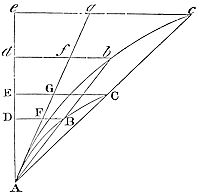
For while the points B, C, approach towards the point A, suppose always AD to be produced to the remote points d and e, so as Ad, Ae may be proportional to AD, AE; and the ordinates db, ec, to be drawn parallel to the ordinates DB and EC, and meeting AB and AC produced in b and c. Let the curve Abc be similar to the curve ABC, and draw the right line Ag so as to touch both curves in A, and cut the ordinates DB, EC, db, ec, in F, G, f, g. Then, supposing the length Ae to remain the same, let the points B and C meet in the point A; and the angle cAg vanishing, the curvilinear areas Abd, Ace will coincide with the rectilinear areas Afd, Age; and therefore (by Lem. V) will be one to the other in the duplicate ratio of the sides Ad, Ae. But the areas ABD, ACE are always proportional to these areas; and so the sides AD, AE are to these sides. And therefore the areas ABD, ACE are ultimately one to the other in the duplicate ratio of the sides AD, AE. Q.E.D.