If to the several points of any circle there tend equal centripetal forces, increasing or decreasing in any ratio of the distances; it is required to find the force with which a corpuscle is attracted, that is, situate any where in a right line which stands at right angles to the plane of the circle at its centre.
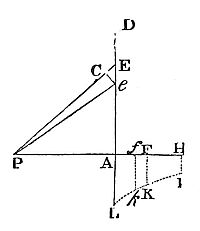
Suppose a circle to be described about the centre A with any interval AD in a plane to which the right line AP is perpendicular; and let it be required to find the force with which a corpuscle P is attracted towards the same. From any point E of the circle, to the attracted corpuscle P, let there be drawn the right line PE. In the right line PA take PF equal to PE, and make a perpendicular FK, erected at F, to be as the force with which the point E attracts the corpuscle P. And let the curve line IKL be the locus of the point K. Let that curve meet the plane of the circle in L. In PA take PH equal to PD, and erect the perpendicular HI meeting that curve in I; and the attraction of the corpuscle P towards the circle will be as the area AHIL drawn into the altitude AP. Q.E.I.
For let there be taken in AE a very small line Ee. Join Pe, and in PE, PA take PC, Pf equal to Pe. And because the force, with which any point E of the annulus described about the centre A with the interval AE in the aforesaid plane attracts to itself the body P, is supposed to be as FK; and, therefore, the force with which that point attracts the body P towards A is as (AP × FK)/PE; and the force with which the whole annulus attracts the body P towards A is as the annulus and (AP × FK)/PE conjunctly; and that annulus also is as the rectangle under the radius AE and the breadth Ee, and this rectangle (because PE and AE, Ee and CE are proportional) is equal to the rectangle PE × CE or PE × Ff; the force with which that annulus attracts the body P towards A will be as PE × Ff and (AP × FK)/PE conjunctly; that is, as the content under Ff × FK AP, or as the area FKkf drawn into AP. And therefore the sum of the forces with which all the annuli, in the circle described about the centre A with the interval AD, attract the body P towards A, is as the whole area AHIKL drawn into AP. Q.E.D.
COR. 1. Hence if the forces of the points decrease in the duplicate ratio of the distances, that is, if FK be as 1/PF², and therefore the area AHIKL as 1/PA−1/PH; the attraction of the corpuscle P towards the circle will be as 1−PA/PH; that is, as AH/PH.
COR. 2. And universally if the forces of the points at the distances D be reciprocally as any power Dn of the distances; that is, if FK be as 1/Dⁿ and therefore the area AHIKL as 1/PAⁿ⁻¹−1/PHⁿ⁻¹; the attraction of the corpuscle P towards the circle will be as 1/PAⁿ⁻²−PA/PHⁿ⁻¹.
COR. 3. And if the diameter of the circle be increased in infinitum, and the number n be greater than unity; the attraction of the corpuscle P towards the whole infinite plane will be reciprocally as PHⁿ⁻², because the other term PA/PHⁿ⁻¹ vanishes.