The same things being supposed, I say that the ultimate ratio of the arc, chord, and tangent, any one to any other, is the ratio of equality.
For while the point B approaches towards the point A, consider always AB and AD as produced to the remote points b and d, and parallel to the secant BD draw bd: and let the arc Acb be always similar to the arc ACB. Then, supposing the points A and B to coincide, the angle dAb will vanish, by the preceding Lemma; and therefore the right lines Ab, Ad (which are always finite), and the intermediate arc Acb, will coincide, and become equal among themselves. Wherefore, the right lines AB, AD, and the intermediate arc ACB (which are always proportional to the former), will vanish, and ultimately acquire the ratio of equality. Q.E.D.
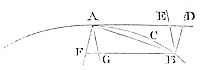
COR. 1. Whence if through B we draw BF parallel to the tangent, always cutting any right line AF passing through A in F, this line BF will be ultimately in the ratio of equality with the evanescent arc ACB; because, completing the parallelogram AFBD, it is always in a ratio of equality with AD.
COR. 2. And if through B and A more right lines are drawn, as BE, BD, AF, AG, cutting the tangent AD and its parallel BF; the ultimate ratio of all the abscissas AD, AE, BF, BG, and of the chord and arc AB, any one to any other, will be the ratio of equality.
COR. 3. And therefore in all our reasoning about ultimate ratios, we may freely use any one of those lines for any other.