If two bodies attract each other mutually with forces of any kind, and in the mean time revolve about the common centre of gravity; I say, that, by the same forces, there may be described round either body unmoved a figure similar and equal to the figures which the bodies so moving describe round each other mutually.
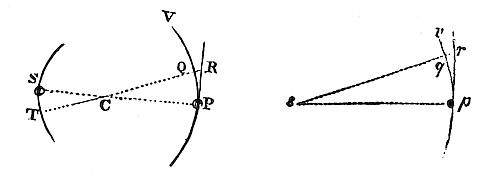
Let the bodies S and P revolve about their common centre of gravity C, proceeding from S to T, and from P to Q. From the given point s let there be continually drawn sp, sq, equal and parallel to SP, TQ; and the curve pqv, which the point p describes in its revolution round the immovable point s, will be similar and equal to the curves which the bodies S and P describe about each other mutually; and therefore, by Theor. XX, similar to the curves ST and PQV which the same bodies describe about their common centre of gravity C; and that because the proportions of the lines SC, CP, and SP or sp, to each other, are given.
CASE 1. The common centre of gravity C (by Cor. 4, of the Laws of Motion) is either at rest, or moves uniformly in a right line. Let us first suppose it at rest, and in s and p let there be placed two bodies, one immovable in s, the other movable in p, similar and equal to the bodies S and P. Then let the right lines PR and pr touch the curves PQ and pq in P and p, and produce CQ and sq to R and r. And because the figures CPRQ, sprq are similar, RQ will be to rq as CP to sp, and therefore in a given ratio. Hence if the force with which the body P is attracted towards the body S, and by consequence towards the intermediate point the centre C, were to the force with which the body p is attracted towards the centre s, in the same given ratio, these forces would in equal times attract the bodies from the tangents PR, pr to the arcs PQ, pq, through the intervals proportional to them RQ, rq; and therefore this last force (tending to s) would make the body p revolve in the curve pqv, which would become similar to the curve PQV, in which the first force obliges the body P to revolve; and their revolutions would be completed in the same times. But because those forces are not to each other in the ratio of CP to sp, but (by reason of the similarity and equality of the bodies S and s, P and p and the equality of the distances SP, sp) mutually equal, the bodies in equal times will be equally drawn from the tangents; and therefore that the body p may be attracted through the greater interval rq, there is required a greater time, which will be in the subduplicate ratio of the intervals; because, by Lemma X, the spaces described at the very beginning of the motion are in a duplicate ratio of the times. Suppose, then the velocity of the body p to be to the velocity of the body P in a subduplicate ratio of the distance sp to the distance CP, so that the arcs pq, PQ, which are in a simple proportion to each other, may be described in times that are in a subduplicate ratio of the distances; and the bodies P, p, always attracted by equal forces, will describe round the quiescent centres C and s similar figures PQV, pqv, the latter of which pqv is similar and equal to the figure which the body P describes round the movable body S. Q.E.D.
CASE 2. Suppose now that the common centre of gravity, together with the space in which the bodies are moved among themselves, proceeds uniformly in a right line; and (by Cor. 6, of the Laws of Motion) all the motions in this space will be performed in the same manner as before; and therefore the bodies will describe mutually about each other the same figures as before, which will be therefore similar and equal to the figure pqv. Q.E.D.
COR. 1. Hence two bodies attracting each other with forces proportional to their distance, describe (by Prop. X) both round their common centre of gravity, and round each other mutually concentrical ellipses; and, vice versa, if such figures are described, the forces are proportional to the distances.
COR. 2. And two bodies, whose forces are reciprocally proportional to the square of their distance, describe (by Prop. XI, XII, XIII), both round their common centre of gravity, and round each other mutually, conic sections having their focus in the centre about which the figures are described. And, vice versa, if such figures are described, the centripetal forces are reciprocally proportional to the squares of the distance.
COR. 3. Any two bodies revolving round their common centre of gravity describe areas proportional to the times, by radii drawn both to that centre and to each other mutually.