Given the sublimity and the altitude of a parabola, to find its amplitude.
Let the line ac, in which lie the given altitude cb and sublimity ab, be perpendicular to the horizontal line cd. The problem is to find the amplitude, along the horizontal cd, of the semi-parabola which is described with the sublimity ba and altitude bc. Lay off cd equal to twice the mean proportional between cb and ba. Then cd will be the amplitude sought, as is evident from the preceding proposition.
Theoremposition. Pro VII
If projectiles describe semi-parabolas of the same amplitude, the momentum required to describe that one whose amplitude is double its altitude is less than that required for any other.
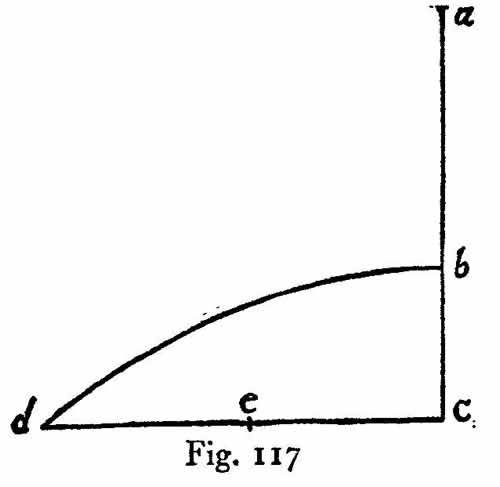
Let bd be a semi-parabola whose amplitude cd is double its altitude cb; on its axis extended upwards lay off ba equal to its altitude bc. Draw the line ad which will be a tangent to the parabola at d and will cut the horizontal line be at the point e, making be equal to bc and also to ba. It is evident that this parabola will be described by a projectile whose uniform horizontal momentum is that which it would acquire at b in falling from rest at a and whose naturally accelerated vertical momentum is that of the body falling to c, from rest at b. From this it follows that the momentum at the terminal point d, compounded of these two, is represented by the diagonal ae, whose square is equal to the sum of the squares of the two components. Now let gd be any other parabola whatever having the same amplitude cd, but whose altitude cg is either greater or less than the altitude bc. Let hd be the tangent cutting the horizontal through g at k. Select a point l such that hg:gk=gk:gl. Then from a preceding proposition, it follows that gl will be the height from which a body must fall in order to describe the parabola gd.
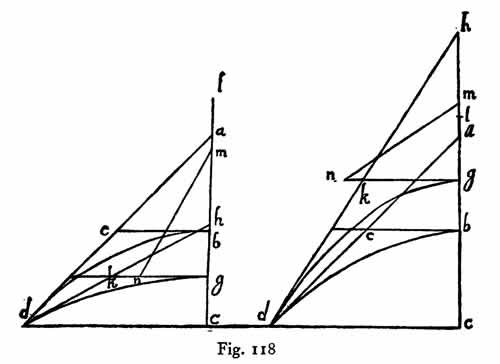
Let gm be a mean proportional between ab and gl; then gm will [Prop. IV] represent the time and momentum acquired at g by a fall from l; for ab has been assumed as a measure of both time and momentum. Again let gn be a mean proportional between bc and cg; it will then represent the time and momentum which the body acquires at c in falling from g. If now we join m and n, this line mn will represent the momentum at d of the projectile traversing the parabola dg; which momentum is, I say, greater than that of the projectile travelling along the parabola bd whose measure was given by ae. For since gn has been taken as a mean proportional between bc and gc; and since bc is equal to be and also to kg (each of them being the half of dc) it follows that cg:gn=gn:gk, and as cg or (hg) is to gk so is to ngmacronsup2 to gkmacronsup2: but by construction hg:gk=gk:gl. Hence ngmacronsup2:gkmacronsup2_=_gk:gl. But gk:gl=gkmacronsup2:gmmacronsup2, since gm is a mean proportional between kg and gl. Therefore the three squares ng, kg, mg form a continued proportion, gnmacronsup2:gkmacronsup2=_gkmacronsup2_:gmmacrondotsup2 And the sum of the two extremes which is equal to the square of mn is greater than twice the square of gk; but the square of ae is double the square of gk. Hence the square of mn is greater than the square of ae and the length mn is greater than the length ae.
q. e. d.
COROLLARY
Conversely it is evident that less momentum will be required to send a projectile from the terminal point d along the parabola bd than along any other parabola having an elevation greater or less than that of the parabola bd, for which the tangent at d makes an angle of 45° with the horizontal. From which it follows that if projectiles are fired from the terminal point d, all having the same speed, but each having a different elevation, the maximum range, i. e., amplitude of the semi-parabola or of the entire parabola, will be obtained when the elevation is 45°: the other shots, fired at angles greater or less will have a shorter range.
The force of rigid demonstrations such as occur only in mathematics fills me with wonder and delight. From accounts given by gunners, I was already aware of the fact that in the use of cannon and mortars, the maximum range, that is the one in which the shot goes farthest, is obtained when the elevation is 45° or, as they say, at the sixth point of the quadrant; but to understand why this happens far outweighs the mere information obtained by the testimony of others or even by repeated experiment.
What you say is very true. The knowledge of a single fact acquired through a discovery of its causes prepares the mind to understand and ascertain other facts without need of recourse to experiment, precisely as in the present case, where by argumentation alone the Author proves with certainty that the maximum range occurs when the elevation is 45°. He thus demonstrates what has perhaps never been observed in experience, namely, that of other shots those which exceed or fall short of 45° by equal amounts have equal ranges; so that if the balls have been fired one at an elevation of 7 points, the other at 5, they will strike the level at the same distance: the same is true if the shots are fired at 8 and at 4 points, at 9 and at 3, etc. Now let us hear the demonstration of this.
Theorem. Proposition VIII
The amplitudes of two parabolas described by projectiles fired with the same speed, but at angles of elevation which exceed and fall short of 45° by equal amounts, are equal to each other.
In the triangle mcb let the horizontal side bc and the vertical cm, which form a right angle at c, be equal to each other; then the angle mbc will be a semi-right angle; let the line cm be prolonged to d, such a point that the two angles at b, namely mbe and mbd, one above and the other below the diagonal mb, shall be equal. It is now to be proved that in the case of two parabolas described by two projectiles fired from b with the same speed, one at the angle of ebc, the other at the angle of dbc, their amplitudes will be equal. Now since the external angle bmc is equal to the sum of the internal angles mdb and dbm we may also equate to them the angle mbc; but if we replace the angle dbm by mbe, then this same angle mbc is equal to the two mbe and bdc: and if we subtract from each side of this equation the angle mbe, we have the remainder bdc equal to the remainder ebc. Hence the two triangles dcb and bce are similar. Bisect the straight lines dc and ec in the points h and f: and draw the lines hi and fg parallel to the horizontal cb, and choose l such that dh:hi=ih:hl. Then the triangle ihl will be similar to ihd, and also to the triangle egf; and since ih and gf are equal, each being half of bc, it follows that hl is equal to fe and also to fc; and if we add to each of these the common part fh, it will be seen that ch is equal to fl.
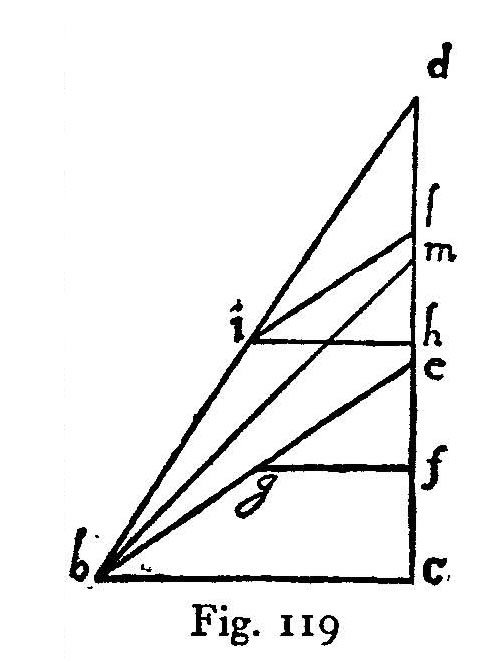
Let us now imagine a parabola described through the points h and b whose altitude is hc and sublimity hl. Its amplitude will be cb which is double the length hi since hi is a mean proportional between dh (or ch) and hl. The line db is tangent to the parabola at b, since ch is equal to hd. If again we imagine a parabola described through the points f and b, with a sublimity fl and altitude fc, of which the mean proportional is fg, or one-half of cb, then, as before, will cb be the amplitude and the line eb a tangent at b; for ef and fc are equal.
But the two angles dbc and ebc, the angles of elevation, differ by equal amounts from a 45° angle. Hence follows the proposition.
Theorem. Proposition IX
The amplitudes of two parabolas are equal when their altitudes and sublimities are inversely proportional.
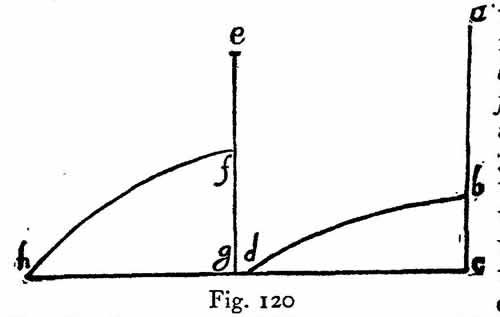
Let the altitude gf of the parabola fh bear to the altitude cb of the parabola bd the same ratio which the sublimity ba bears to the sublimity fe; then I say the amplitude hg is equal to the amplitude dc. For since the first of these quantities, gf, bears to the second cb the same ratio which the third, ba, bears to the fourth fe, it follows that the area of the rectangle gf.fe is equal to that of the rectangle cb.ba; therefore squares which are equal to these rectangles are equal to each other. But [by Proposition VI] the square of half of gh is equal to the rectangle gf.fe; and the square of half of cd is equal to the rectangle cb.ba. Therefore these squares and their sides and the doubles of their sides are equal. But these last are the amplitudes gh and cd. Hence follows the proposition.
Lemma for the following Proposition
If a straight line be cut at any point whatever and mean proportionals between this line and each of its parts be taken, the sum of the squares of these mean proportionals is equal to the square of the entire line.
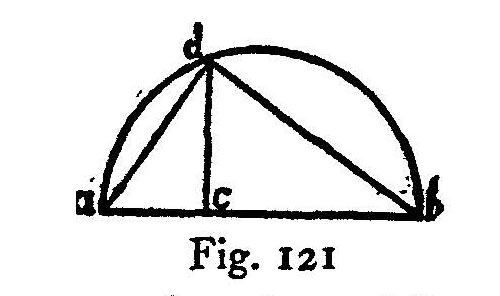
Let the line ab be cut at c. Then I say that the square of the mean proportional between ab and ac plus the square of the mean proportional between ab and cb is equal to the square of the whole line ab. This is evident as soon as we describe a semicircle upon the entire line ab, erect a perpendicular cd at c, and draw da and db. For da is a mean proportional between ab and ac while db is a mean proportional between ab and bc: and since the angle adb, inscribed in a semicircle, is a right angle the sum of the squares of the lines da and db is equal to the square of the entire line ab. Hence follows the proposition.
Theorem. Proposition X
The momentum [impetus seu momentum] acquired by a particle at the terminal point of any semi-parabola is equal to that which it would acquire in falling through a vertical distance equal to the sum of the sublimity and the altitude of the semi-parabola.
Let ab be a semi-parabola having a sublimity da and an altitude ac, the sum of which is the perpendicular dc. Now I say the momentum of the particle at b is the same as that which it would acquire in falling freely from d to c. Let us take the length of dc itself as a measure of time and momentum, and lay off cf equal to the mean proportional between cd and da; also lay off ce a mean proportional between cd and ca. Now cf is the measure of the time and of the momentum acquired by fall, from rest at d, through the distance da; while ce is the time and momentum of fall, from rest at a, through the distance ca; also the diagonal ef will represent a momentum which is the resultant of these two, and is therefore the momentum at the terminal point of the parabola, b.
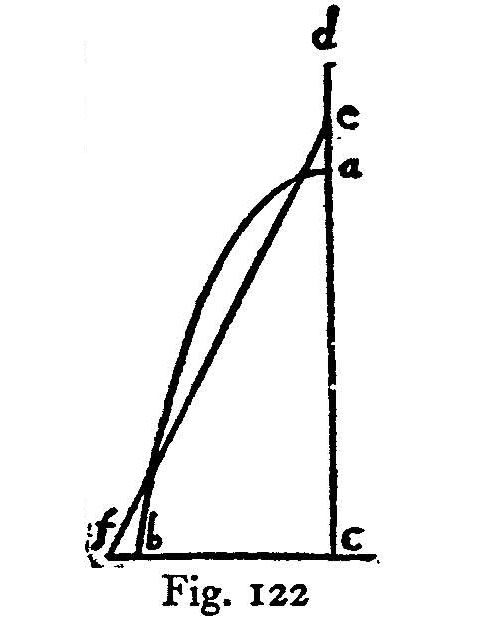
And since dc has been cut at some point a and since cf and ce are mean proportionals between the whole of cd and its parts, da and ac, it follows, from the preceding lemma, that the sum of the squares of these mean proportionals is equal to the square of the whole: but the square of ef is also equal to the sum of these same squares; whence it follows that the line ef is equal to dc.
Accordingly the momentum acquired at c by a particle in falling from d is the same as that acquired at b by a particle traversing the parabola ab.
q. e. d.
COROLLARY
Hence it follows that, in the case of all parabolas where the sum of the sublimity and altitude is a constant, the momentum at the terminal point is a constant.
Problem. Proposition XI
Given the amplitude and the speed [impetus] at the terminal point of a semi-parabola, to find its altitude.
Let the given speed be represented by the vertical line ab, and the amplitude by the horizontal line bc; it is required to find the sublimity of the semi-parabola whose terminal speed is ab and amplitude bc. From what precedes [Cor. Prop. V] it is clear that half the amplitude bc is a mean proportional between the altitude and sublimity of the parabola of which the terminal speed is equal, in accordance with the preceding proposition, to the speed acquired by a body in falling from rest at a through the distance ab. Therefore the line ba must be cut at a point such that the rectangle formed by its two parts will be equal to the square of half bc, namely bd. Necessarily, therefore, bd must not exceed the half of ba; for of all the rectangles formed by parts of a straight line the one of greatest area is obtained when the line is divided into two equal parts. Let e be the middle point of the line ab; and now if bd be equal to be the problem is solved; for be will be the altitude and ea the sublimity of the parabola. (Incidentally we may observe a consequence already demonstrated, namely: of all parabolas described with any given terminal speed that for which the elevation is 45° will have the maximum amplitude.)
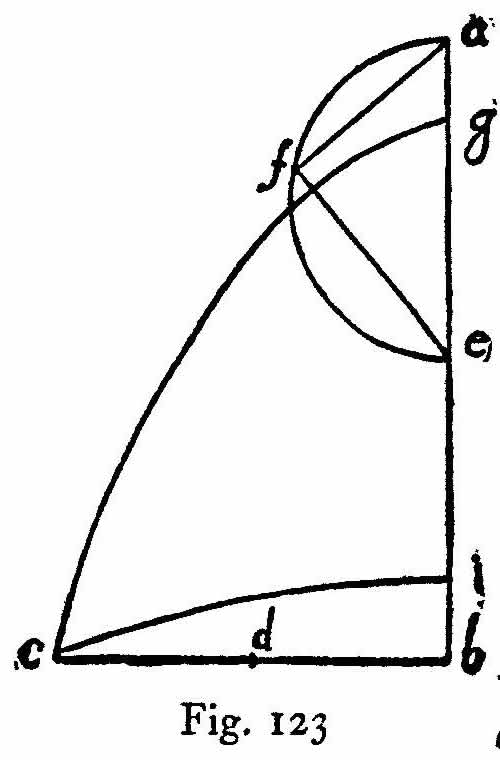
But suppose that bd is less than half of ba which is to be divided in such a way that the rectangle upon its parts may be equal to the square of bd. Upon ea as diameter describe a semicircle efa, in which draw the chord af, equal to bd: join fe and lay off the distance eg equal to fe. Then the rectangle bg.ga plus the square of eg will be equal to the square of ea, and hence also to the sum of the squares of af and fe. If now we subtract the equal squares of fe and ge there remains the rectangle bg.ga equal to the square of af, that is, of bd, a line which is a mean proportional between bg and ga; from which it is evident that the semi-parabola whose amplitude is bc and whose terminal speed [impetus] is represented by ba has an altitude bg and a sublimity ga.
If however we lay off bi equal to ga, then bi will be the altitude of the semi-parabola ic, and ia will be its sublimity. From the preceding demonstration we are able to solve the following problem.
Problem. Proposition XII
To compute and tabulate the amplitudes of all semi-parabolas which are described by projectiles fired with the same initial speed [impetus].
From the foregoing it follows that, whenever the sum of the altitude and sublimity is a constant vertical height for any set of parabolas, these parabolas are described by projectiles having the same initial speed; all vertical heights thus obtained are therefore included between two parallel horizontal lines. Let cb represent a horizontal line and ab a vertical line of equal length; draw the diagonal ac; the angle acb will be one of 45°; let d be the middle point of the vertical line ab. Then the semi-parabola dc is the one which is determined by the sublimity ad and the altitude db, while its terminal speed at c is that which would be acquired at b by a particle falling from rest at a. If now ag be drawn parallel to bc, the sum of the altitude and sublimity for any other semi-parabola having the same terminal speed will, in the manner explained, be equal to the distance between the parallel lines ag and bc. Moreover, since it has already been shown that the amplitudes of two semi-parabolas are the same when their angles of elevation differ from 45° by like amounts, it follows that the same computation which is employed for the larger elevation will serve also for the smaller. Let us also assume 10000 as the greatest amplitude for a parabola whose angle of elevation is 45°; this then will be the length of the line ba and the amplitude of the semi-parabola bc. This number, 10000, is selected because in these calculations we employ a table of tangents in which this is the value of the tangent of 45°. And now, coming down to business, draw the straight line ce making an acute angle ecb greater than acb: the problem now is to draw the semi-parabola to which the line ec is a tangent and for which the sum of the sublimity and the altitude is the distance ba. Take the length of the tangent be from the table of tangents, using the angle bce as an argument: let f be the middle point of be; next find a third proportional to bf and bi (the half of bc), which is of necessity greater than fa. Call this fo. We have now discovered that, for the parabola inscribed in the triangle ecb having the tangent ce and the amplitude cb, the altitude is bf and the sublimity fo. But the total length of bo exceeds the distance between the parallels ag and cb, while our problem was to keep it equal to this distance: for both the parabola sought and the parabola dc are described by projectiles fired from c with the same speed. Now since an infinite number of greater and smaller parabolas, similar to each other, may be described within the angle bce we must find another parabola which like cd has for the sum of its altitude and sublimity the height ba, equal to bc.
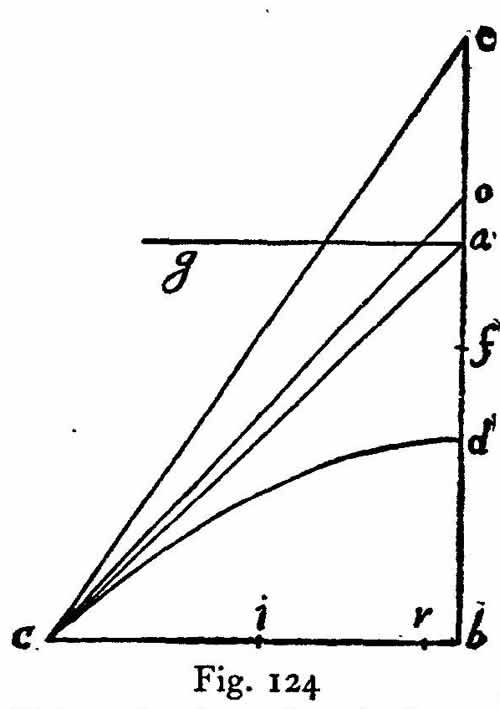
Therefore lay off cr so that, ob:ba=bc:cr; then cr will be the amplitude of a semi-parabola for which bce is the angle of elevation and for which the sum of the altitude and sublimity is the distance between the parallels ga and cb, as desired. The process is therefore as follows: One draws the tangent of the given angle bce; takes half of this tangent, and adds to it the quantity, fo, which is a third proportional to the half of this tangent and the half of bc; the desired amplitude cr is then found from the following proportion ob:ba=bc:cr. For example let the angle ecb be one of 50°; its tangent is 11918, half of which, namely bf, is 5959; half of bc is 5000; the third proportional of these halves is 4195, which added to bf gives the value 10154 for bo. Further, as ob is to ab, that is, as 10154 is to 10000, so is bc, or 10000 (each being the tangent of 45°) to cr, which is the amplitude sought and which has the value 9848, the maximum amplitude being bc, or 10000. The amplitudes of the entire parabolas are double these, namely, 19696 and 20000. This is also the amplitude of a parabola whose angle of elevation is 40°, since it deviates by an equal amount from one of 45°.
In order to thoroughly understand this demonstration I need to be shown how the third proportional of bf and bi is, as the Author indicates, necessarily greater than fa.
This result can, I think, be obtained as follows. The square of the mean proportional between two lines is equal to the rectangle formed by these two lines. Therefore the square of bi (or of bd which is equal to bi) must be equal to the rectangle formed by fb and the desired third proportional. This third proportional is necessarily greater than fa because the rectangle formed by bf and fa is less than the square of bd by an amount equal to the square of df, as shown in Euclid, II. 1. Besides it is to be observed that the point f, which is the middle point of the tangent eb, falls in general above a and only once at a; in which cases it is self-evident that the third proportional to the half of the tangent and to the sublimity bi lies wholly above a. But the Author has taken a case where it is not evident that the third proportional is always greater than fa, so that when laid off above the point f it extends beyond the parallel ag.
Now let us proceed. It will be worth while, by the use of this table, to compute another giving the altitudes of these semi-parabolas described by projectiles having the same initial speed. The construction is as follows:
Problem. Proposition XIII
From the amplitudes of semi-parabolas given in the preceding table to find the altitudes of each of the parabolas described with the same initial speed.
Let bc denote the given amplitude; and let ob, the sum of the altitude and sublimity, be the measure of the initial speed which is understood to remain constant. Next we must find and determine the altitude, which we shall accomplish by so dividing ob that the rectangle contained by its parts shall be equal to the square of half the amplitude, bc. Let f denote this point of division and d and i be the middle points of ob and bc respectively. The square of ib is equal to the rectangle bf.fo; but the square of do is equal to the sum of the rectangle bf.fo and the square of fd. If, therefore, from the square of do we subtract the square of bi which is equal to the rectangle bf.fo, there will remain the square of fd. The altitude in question, bf, is now obtained by adding to this length, fd, the line bd. The process is then as follows: From the square of half of bo which is known, subtract the square of bi which is also known; take the square root of the remainder and add to it the known length db; then you have the required altitude, bf.
Example. To find the altitude of a semi-parabola described with an angle of elevation of 55°. From the preceding table the amplitude is seen to be 9396, of which the half is 4698, and the square 22071204. When this is subtracted from the square of the half of bo, which is always 25,000,000, the remainder is 2928796, of which the square root is approximately 1710. Adding this to the half of bo, namely 5000, we have 6710 for the altitude of bf.
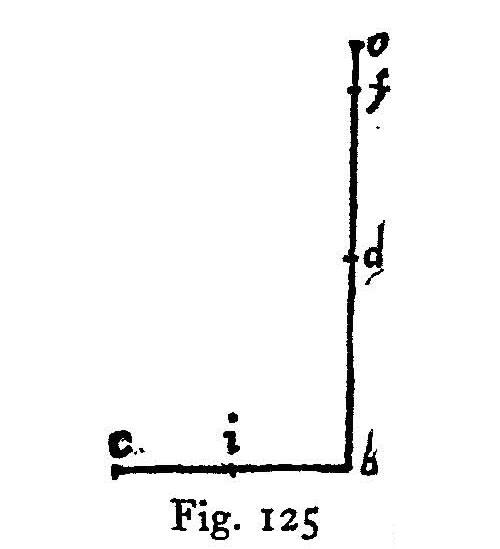
It will be worth while to add a third table giving the altitudes and sublimities for parabolas in which the amplitude is a constant.
I shall be very glad to see this; for from it I shall learn the difference of speed and force [degl’ impeti e delle forze] required to fire projectiles over the same range with what we call mortar shots. This difference will, I believe, vary greatly with the elevation so that if, for example, one wished to employ an elevation of 3° or 4°, or 87° or 88° and yet give the ball the same range which it had with an elevation of 45° (where we have shown the initial speed to be a minimum) the excess of force required will, I think, be very great.
You are quite right, sir; and you will find that in order to perform this operation completely, at all angles of elevation, you will have to make great strides toward an infinite speed. We pass now to the consideration of the table.