A projectile which is carried by a uniform horizontal motion compounded with a naturally accelerated vertical motion describes a path which is a semi-parabola.
Here, Salviati, it will be necessary to stop a little while for my sake and, I believe, also for the benefit of Simplicio; for it so happens that I have not gone very far in my study of Apollonius and am merely aware of the fact that he treats of the parabola and other conic sections, without an understanding of which I hardly think one will be able to follow the proof of other propositions depending upon them. Since even in this first beautiful theorem the author finds it necessary to prove that the path of a projectile is a parabola, and since, as I imagine, we shall have to deal with only this kind of curves, it will be absolutely necessary to have a thorough acquaintance, if not with all the properties which Apollonius has demonstrated for these figures, at least with those which are needed for the present treatment.
You are quite too modest, pretending ignorance of facts which not long ago you acknowledged as well known—I mean at the time when we were discussing the strength of materials and needed to use a certain theorem of Apollonius which gave you no trouble.
I may have chanced to know it or may possibly have assumed it, so long as needed, for that discussion; but now when we have to follow all these demonstrations about such curves we ought not, as they say, to swallow it whole, and thus waste time and energy.
Now even though Sagredo is, as I believe, well equipped for all his needs, I do not understand even the elementary terms; for although our philosophers have treated the motion of projectiles, I do not recall their having described the path of a projectile except to state in a general way that it is always a curved line, unless the projection be vertically upwards. But if the little Euclid which I have learned since our previous discussion does not enable me to understand the demonstrations which are to follow, then I shall be obliged to accept the theorems on faith without fully comprehending them.
On the contrary, I desire that you should understand them from the Author himself, who, when he allowed me to see this work of his, was good enough to prove for me two of the principal properties of the parabola because I did not happen to have at hand the books of Apollonius. These properties, which are the only ones we shall need in the present discussion, he proved in such a way that no prerequisite knowledge was required. These theorems are, indeed, given by Apollonius, but after many preceding ones, to follow which would take a long while. I wish to shorten our task by deriving the first property purely and simply from the mode of generation of the parabola and proving the second immediately from the first.
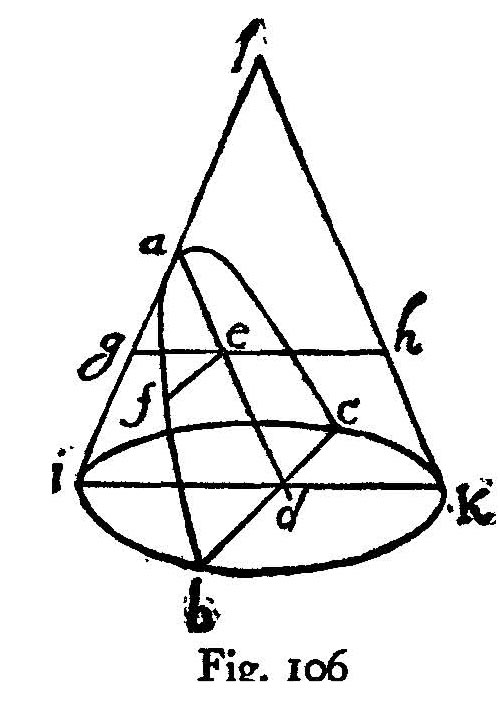
Beginning now with the first, imagine a right cone, erected upon the circular base ibkc with apex at l. The section of this cone made by a plane drawn parallel to the side lk is the curve which is called a parabola. The base of this parabola bc cuts at right angles the diameter ik of the circle ibkc, and the axis ad is parallel to the side lk; now having taken any point f in the curve bfa draw the straight line fe parallel to bd; then, I say, the square of bd is to the square of fe in the same ratio as the axis ad is to the portion ae. Through the point e pass a plane parallel to the circle ibkc, producing in the cone a circular section whose diameter is the line geh. Since bd is at right angles to ik in the circle ibk, the square of bd is equal to the rectangle formed by id and dk; so also in the upper circle which passes through the points gfh the square of fe is equal to the rectangle formed by ge and eh; hence the square of bd is to the square of fe as the rectangle id.dk is to the rectangle ge.eh. And since the line ed is parallel to hk, the line eh, being parallel to dk, is equal to it; therefore the rectangle id.dk is to the rectangle ge.eh as id is to ge, that is, as da is to ae; whence also the rectangle id.dk is to the rectangle ge.eh, that is, the square of bd is to the square of fe, as the axis da is to the portion ae.
q. e. d.
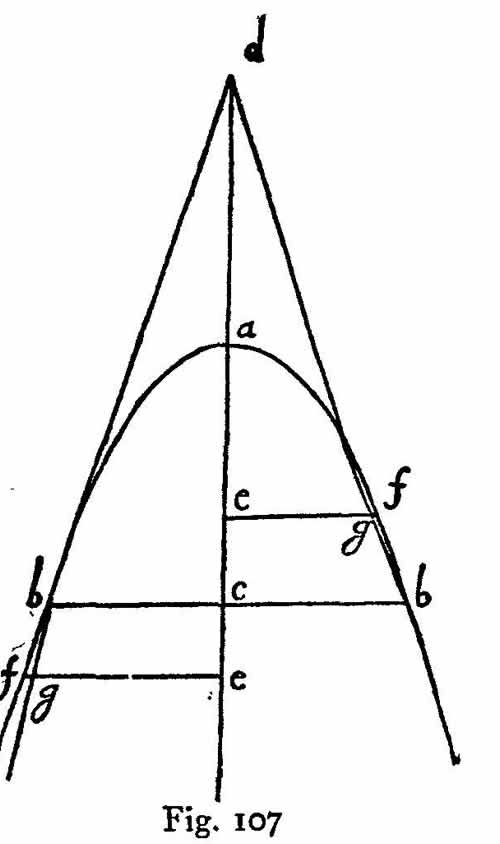
The other proposition necessary for this discussion we demonstrate as follows. Let us draw a parabola whose axis ca is prolonged upwards to a point d; from any point b draw the line bc parallel to the base of the parabola; if now the point d is chosen so that da = ca, then, I say, the straight line drawn through the points b and d will be tangent to the parabola at b. For imagine, if possible, that this line cuts the parabola above or that its prolongation cuts it below, and through any point g in it draw the straight line fge. And since the square of fe is greater than the square of ge, the square of fe will bear a greater ratio to the square of bc than the square of ge to that of bc; and since, by the preceding proposition, the square of fe is to that of bc as the line ea is to ca, it follows that the line ea will bear to the line ca a greater ratio than the square of ge to that of bc, or, than the square of ed to that of cd (the sides of the triangles deg and dcb being proportional). But the line ea is to ca, or da, in the same ratio as four times the rectangle ea.ad is to four times the square of ad, or, what is the same, the square of cd, since this is four times the square of ad; hence four times the rectangle ea.ad bears to the square of cd a greater ratio than the square of ed to the square of cd; but that would make four times the rectangle ea.ad greater than the square of ed; which is false, the fact being just the opposite, because the two portions ea and ad of the line ed are not equal. Therefore the line db touches the parabola without cutting it.
q. e. d.
Your demonstration proceeds too rapidly and, it seems to me, you keep on assuming that all of Euclid’s theorems are as familiar and available to me as his first axioms, which is far from true. And now this fact which you spring upon us, that four times the rectangle ea.ad is less than the square of de because the two portions ea and ad of the line de are not equal brings me little composure of mind, but rather leaves me in suspense.
Indeed, all real mathematicians assume on the part of the reader perfect familiarity with at least the elements of Euclid; and here it is necessary in your case only to recall a proposition of the Second Book in which he proves that when a line is cut into equal and also into two unequal parts, the rectangle formed on the unequal parts is less than that formed on the equal (i. e., less than the square on half the line), by an amount which is the square of the difference between the equal and unequal segments. From this it is clear that the square of the whole line which is equal to four times the square of the half is greater than four times the rectangle of the unequal parts. In order to understand the following portions of this treatise it will be necessary to keep in mind the two elemental theorems from conic sections which we have just demonstrated; and these two theorems are indeed the only ones which the Author uses. We can now resume the text and see how he demonstrates his first proposition in which he shows that a body falling with a motion compounded of a uniform horizontal and a naturally accelerated [naturale descendente] one describes a semi-parabola.
Let us imagine an elevated horizontal line or plane ab along which a body moves with uniform speed from a to b. Suppose this plane to end abruptly at b; then at this point the body will, on account of its weight, acquire also a natural motion downwards along the perpendicular bn. Draw the line be along the plane ba to represent the flow, or measure, of time; divide this line into a number of segments, bc, cd, de, representing equal intervals of time; from the points b, c, d, e, let fall lines which are parallel to the perpendicular bn. On the first of these lay off any distance ci, on the second a distance four times as long, df; on the third, one nine times as long, eh; and so on, in proportion to the squares of cb, db, eb, or, we may say, in the squared ratio of these same lines. Accordingly we see that while the body moves from b to c with uniform speed, it also falls perpendicularly through the distance ci, and at the end of the time-interval bc finds itself at the point i. In like manner at the end of the time-interval bd, which is the double of bc, the vertical fall will be four times the first distance ci; for it has been shown in a previous discussion that the distance traversed by a freely falling body varies as the square of the time; in like manner the space eh traversed during the time be will be nine times ci; thus it is evident that the distances eh, df, ci will be to one another as the squares of the lines be, bd, bc. Now from the points i, f, h draw the straight lines io, fg, hl parallel to be; these lines hl, fg, io are equal to eb, db and cb, respectively; so also are the lines bo, bg, bl respectively equal to ci, df, and eh. The square of hl is to that of fg as the line lb is to bg; and the square of fg is to that of io as gb is to bo; therefore the points i, f, h, lie on one and the same parabola. In like manner it may be shown that, if we take equal time-intervals of any size whatever, and if we imagine the particle to be carried by a similar compound motion, the positions of this particle, at the ends of these time-intervals, will lie on one and the same parabola.
q. e. d.
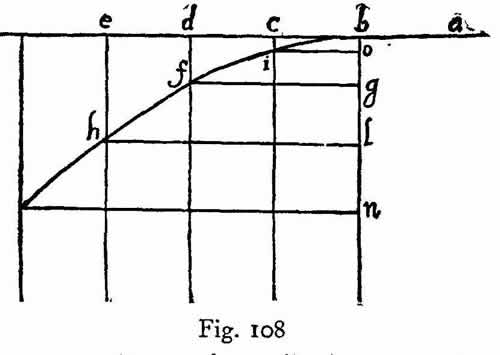
This conclusion follows from the converse of the first of the two propositions given above. For, having drawn a parabola through the points b and h, any other two points, f and i, not falling on the parabola must lie either within or without; consequently the line fg is either longer or shorter than the line which terminates on the parabola. Therefore the square of hl will not bear to the square of fg the same ratio as the line lb to bg, but a greater or smaller; the fact is, however, that the square of hl does bear this same ratio to the square of fg. Hence the point f does lie on the parabola, and so do all the others.
One cannot deny that the argument is new, subtle and conclusive, resting as it does upon this hypothesis, namely, that the horizontal motion remains uniform, that the vertical motion continues to be accelerated downwards in proportion to the square of the time, and that such motions and velocities as these combine without altering, disturbing, or hindering each other, so that as the motion proceeds the path of the projectile does not change into a different curve: but this, in my opinion, is impossible. For the axis of the parabola along which we imagine the natural motion of a falling body to take place stands perpendicular to a horizontal surface and ends at the center of the earth; and since the parabola deviates more and more from its axis no projectile can ever reach the center of the earth or, if it does, as seems necessary, then the path of the projectile must transform itself into some other curve very different from the parabola.
To these difficulties, I may add others. One of these is that we suppose the horizontal plane, which slopes neither up nor down, to be represented by a straight line as if each point on this line were equally distant from the center, which is not the case; for as one starts from the middle [of the line] and goes toward either end, he departs farther and farther from the center [of the earth] and is therefore constantly going uphill. Whence it follows that the motion cannot remain uniform through any distance whatever, but must continually diminish. Besides, I do not see how it is possible to avoid the resistance of the medium which must destroy the uniformity of the horizontal motion and change the law of acceleration of falling bodies. These various difficulties render it highly improbable that a result derived from such unreliable hypotheses should hold true in practice.
All these difficulties and objections which you urge are so well founded that it is impossible to remove them; and, as for me, I am ready to admit them all, which indeed I think our Author would also do. I grant that these conclusions proved in the abstract will be different when applied in the concrete and will be fallacious to this extent, that neither will the horizontal motion be uniform nor the natural acceleration be in the ratio assumed, nor the path of the projectile a parabola, etc. But, on the other hand, I ask you not to begrudge our Author that which other eminent men have assumed even if not strictly true. The authority of Archimedes alone will satisfy everybody. In his Mechanics and in his first quadrature of the parabola he takes for granted that the beam of a balance or steelyard is a straight line, every point of which is equidistant from the common center of all heavy bodies, and that the cords by which heavy bodies are suspended are parallel to each other.
Some consider this assumption permissible because, in practice, our instruments and the distances involved are so small in comparison with the enormous distance from the center of the earth that we may consider a minute of arc on a great circle as a straight line, and may regard the perpendiculars let fall from its two extremities as parallel. For if in actual practice one had to consider such small quantities, it would be necessary first of all to criticise the architects who presume, by use of a plumbline, to erect high towers with parallel sides. I may add that, in all their discussions, Archimedes and the others considered themselves as located at an infinite distance from the center of the earth, in which case their assumptions were not false, and therefore their conclusions were absolutely correct. When we wish to apply our proven conclusions to distances which, though finite, are very large, it is necessary for us to infer, on the basis of demonstrated truth, what correction is to be made for the fact that our distance from the center of the earth is not really infinite, but merely very great in comparison with the small dimensions of our apparatus. The largest of these will be the range of our projectiles—and even here we need consider only the artillery—which, however great, will never exceed four of those miles of which as many thousand separate us from the center of the earth; and since these paths terminate upon the surface of the earth only very slight changes can take place in their parabolic figure which, it is conceded, would be greatly altered if they terminated at the center of the earth.
As to the perturbation arising from the resistance of the medium this is more considerable and does not, on account of its manifold forms, submit to fixed laws and exact description. Thus if we consider only the resistance which the air offers to the motions studied by us, we shall see that it disturbs them all and disturbs them in an infinite variety of ways corresponding to the infinite variety in the form, weight, and velocity of the projectiles. For as to velocity, the greater this is, the greater will be the resistance offered by the air; a resistance which will be greater as the moving bodies become less dense [men gravi]. So that although the falling body ought to be displaced [andare accelerandosi] in proportion to the square of the duration of its motion, yet no matter how heavy the body, if it falls from a very considerable height, the resistance of the air will be such as to prevent any increase in speed and will render the motion uniform; and in proportion as the moving body is less dense [men grave] this uniformity will be so much the more quickly attained and after a shorter fall. Even horizontal motion which, if no impediment were offered, would be uniform and constant is altered by the resistance of the air and finally ceases; and here again the less dense [più leggiero] the body the quicker the process. Of these properties [accidenti] of weight, of velocity, and also of form [figura], infinite in number, it is not possible to give any exact description; hence, in order to handle this matter in a scientific way, it is necessary to cut loose from these difficulties; and having discovered and demonstrated the theorems, in the case of no resistance, to use them and apply them with such limitations as experience will teach. And the advantage of this method will not be small; for the material and shape of the projectile may be chosen, as dense and round as possible, so that it will encounter the least resistance in the medium. Nor will the spaces and velocities in general be so great but that we shall be easily able to correct them with precision.
In the case of those projectiles which we use, made of dense [grave] material and round in shape, or of lighter material and cylindrical in shape, such as arrows, thrown from a sling or crossbow, the deviation from an exact parabolic path is quite insensible. Indeed, if you will allow me a little greater liberty, I can show you, by two experiments, that the dimensions of our apparatus are so small that these external and incidental resistances, among which that of the medium is the most considerable, are scarcely observable.
I now proceed to the consideration of motions through the air, since it is with these that we are now especially concerned; the resistance of the air exhibits itself in two ways: first by offering greater impedance to less dense than to very dense bodies, and secondly by offering greater resistance to a body in rapid motion than to the same body in slow motion.
Regarding the first of these, consider the case of two balls having the same dimensions, but one weighing ten or twelve times as much as the other; one, say, of lead, the other of oak, both allowed to fall from an elevation of 150 or 200 cubits.
Experiment shows that they will reach the earth with slight difference in speed, showing us that in both cases the retardation caused by the air is small; for if both balls start at the same moment and at the same elevation, and if the leaden one be slightly retarded and the wooden one greatly retarded, then the former ought to reach the earth a considerable distance in advance of the latter, since it is ten times as heavy. But this does not happen; indeed, the gain in distance of one over the other does not amount to the hundredth part of the entire fall. And in the case of a ball of stone weighing only a third or half as much as one of lead, the difference in their times of reaching the earth will be scarcely noticeable. Now since the speed [impeto] acquired by a leaden ball in falling from a height of 200 cubits is so great that if the motion remained uniform the ball would, in an interval of time equal to that of the fall, traverse 400 cubits, and since this speed is so considerable in comparison with those which, by use of bows or other machines except fire arms, we are able to give to our projectiles, it follows that we may, without sensible error, regard as absolutely true those propositions which we are about to prove without considering the resistance of the medium.
Passing now to the second case, where we have to show that the resistance of the air for a rapidly moving body is not very much greater than for one moving slowly, ample proof is given by the following experiment. Attach to two threads of equal length—say four or five yards—two equal leaden balls and suspend them from the ceiling; now pull them aside from the perpendicular, the one through 80 or more degrees, the other through not more than four or five degrees; so that, when set free, the one falls, passes through the perpendicular, and describes large but slowly decreasing arcs of 160, 150, 140 degrees, etc.; the other swinging through small and also slowly diminishing arcs of 10, 8, 6, degrees, etc.
In the first place it must be remarked that one pendulum passes through its arcs of 180°, 160°, etc., in the same time that the other swings through its 10°, 8°, etc., from which it follows that the speed of the first ball is 16 and 18 times greater than that of the second. Accordingly, if the air offers more resistance to the high speed than to the low, the frequency of vibration in the large arcs of 180° or 160°, etc., ought to be less than in the small arcs of 10°, 8°, 4°, etc., and even less than in arcs of 2°, or 1°; but this prediction is not verified by experiment; because if two persons start to count the vibrations, the one the large, the other the small, they will discover that after counting tens and even hundreds they will not differ by a single vibration, not even by a fraction of one.
This observation justifies the two following propositions, namely, that vibrations of very large and very small amplitude all occupy the same time and that the resistance of the air does not affect motions of high speed more than those of low speed, contrary to the opinion hitherto generally entertained.
On the contrary, since we cannot deny that the air hinders both of these motions, both becoming slower and finally vanishing, we have to admit that the retardation occurs in the same proportion in each case. But how? How, indeed, could the resistance offered to the one body be greater than that offered to the other except by the impartation of more momentum and speed [impeto e velocità] to the fast body than to the slow? And if this is so the speed with which a body moves is at once the cause and measure [cagione e misura] of the resistance which it meets. Therefore, all motions, fast or slow, are hindered and diminished in the same proportion; a result, it seems to me, of no small importance.
We are able, therefore, in this second case to say that the errors, neglecting those which are accidental, in the results which we are about to demonstrate are small in the case of our machines where the velocities employed are mostly very great and the distances negligible in comparison with the semidiameter of the earth or one of its great circles.
I would like to hear your reason for putting the projectiles of fire arms, i. e., those using powder, in a different class from the projectiles employed in bows, slings, and crossbows, on the ground of their not being equally subject to change and resistance from the air.
I am led to this view by the excessive and, so to speak, supernatural violence with which such projectiles are launched; for, indeed, it appears to me that without exaggeration one might say that the speed of a ball fired either from a musket or from a piece of ordnance is supernatural. For if such a ball be allowed to fall from some great elevation its speed will, owing to the resistance of the air, not go on increasing indefinitely; that which happens to bodies of small density in falling through short distances—I mean the reduction of their motion to uniformity—will also happen to a ball of iron or lead after it has fallen a few thousand cubits; this terminal or final speed [terminata velocità] is the maximum which such a heavy body can naturally acquire in falling through the air. This speed I estimate to be much smaller than that impressed upon the ball by the burning powder.
An appropriate experiment will serve to demonstrate this fact. From a height of one hundred or more cubits fire a gun [archibuso] loaded with a lead bullet, vertically downwards upon a stone pavement; with the same gun shoot against a similar stone from a distance of one or two cubits, and observe which of the two balls is the more flattened. Now if the ball which has come from the greater elevation is found to be the less flattened of the two, this will show that the air has hindered and diminished the speed initially imparted to the bullet by the powder, and that the air will not permit a bullet to acquire so great a speed, no matter from what height it falls; for if the speed impressed upon the ball by the fire does not exceed that acquired by it in falling freely [naturalmente] then its downward blow ought to be greater rather than less.
This experiment I have not performed, but I am of the opinion that a musket-ball or cannon-shot, falling from a height as great as you please, will not deliver so strong a blow as it would if fired into a wall only a few cubits distant, i. e., at such a short range that the splitting or rending of the air will not be sufficient to rob the shot of that excess of supernatural violence given it by the powder.
The enormous momentum [impeto] of these violent shots may cause some deformation of the trajectory, making the beginning of the parabola flatter and less curved than the end; but, so far as our Author is concerned, this is a matter of small consequence in practical operations, the main one of which is the preparation of a table of ranges for shots of high elevation, giving the distance attained by the ball as a function of the angle of elevation; and since shots of this kind are fired from mortars [mortari] using small charges and imparting no supernatural momentum [impeto sopranaturale] they follow their prescribed paths very exactly.
But now let us proceed with the discussion in which the Author invites us to the study and investigation of the motion of a body [impeto del mobile] when that motion is compounded of two others; and first the case in which the two are uniform, the one horizontal, the other vertical.