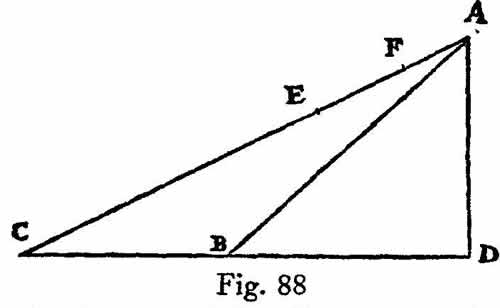
If a body descends along two inclined planes of different lengths but of the same vertical height, the distance which it will traverse, in the lower part of the longer plane, during a time-interval equal to that of descent over the shorter plane, is equal to the length of the shorter plane plus a portion of it to which the shorter plane bears the same ratio which the longer plane bears to the excess of the longer over the shorter plane.
Let AC be the longer plane, AB, the shorter, and AD the common elevation; on the lower part of AC lay off CE equal to AB. Choose F such that CA:AE=CA:CA-AB=CE:EF. Then, I say, that FC is that distance which will, after fall from A, be traversed during a time-interval equal to that required for descent along AB. For since CA:AE=CE:EF, it follows that the remainder EA: the remainder AF = CA:AE. Therefore AE is a mean proportional between AC and AF. Accordingly if the length AB is employed to measure the time of fall along AB, then the distance AC will measure the time of descent through AC; but the time of descent through AF is measured by the length AE, and that through FC by EC. Now EC=AB; and hence follows the proposition.