If two particles are moved at a uniform rate, but with unequal speeds, through unequal distances, then the ratio of the time-intervals occupied will be the product of the ratio of the distances by the inverse ratio of the speeds.
Let the two moving particles be denoted by A and B, and let the speed of A be to the speed of B in the ratio of V to T; in like manner let the distances traversed be in the ratio of S to R; then I say that the ratio of the time-interval during which the motion of A occurs to the time-interval occupied by the motion of B is the product of the ratio of the speed T to the speed V by the ratio of the distance S to the distance R.
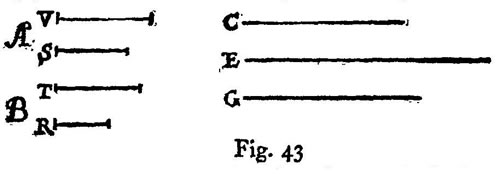
Let C be the time-interval occupied by the motion of A, and let the time-interval C bear to a time-interval E the same ratio as the speed T to the speed V.
And since C is the time-interval during which A, with speed V, traverses the distance S and since T, the speed of B, is to the speed V, as the time-interval C is to the time-interval E, then E will be the time required by the particle B to traverse the distance S. If now we let the time-interval E be to the time-interval G as the distance S is to the distance R, then it follows that G is the time required by B to traverse the space R. Since the ratio of C to G is the product of the ratios C to E and E to G (while also the ratio of C to E is the inverse ratio of the speeds of A and B respectively, i. e., the ratio of T to V); and since the ratio of E to G is the same as that of the distances S and R respectively, the proposition is proved.